Showing posts with label noticing. Show all posts

Wednesday, December 30, 2020

Starting Over, Over And Over

It's funny how we wait for the New Year to start fresh when a new year could start at any moment. People across the world don't even agree on when a new year starts. If you're Julius Caesar you could just randomly decide to shove it up a couple months. Even the time of day is an arbitrary convention. We start a day at midnight but we used to start it at noon and there's really nothing wrong with 3:18 either. Beer-thirty is as precise as we get around here, and even that has been creeping earlier and earlier during the pandemic.

But people do love the idea of a clean sheet to write on. We want to be able to count down to a moment everything can change. Back in the dark ages when I used to write longhand on a legal pad, I had entire paragraphs squashed into the margins and circles around things with arrows pointing to where they really ought to go and cross-outs and underlined bits in boxes tagged with their ultimate destinations, and then I'd sort it all out on a typewriter when I was done. A clean sheet meant little to me. All my stuff was on the marked-up sheet. I wanted every word of it and I could rassle it into shape later. I feel that way about life too. I'm not going to start over; I want to pull all those good bits out of the margins and figure out what order they go in, and what I should cross out, and there's always room to come up with more.

Still, you get a year everyone agrees is truly a crappy year, we're all ready to crumple up the paper and pitch it at the can, and maybe set fire to it first. So that's what we're going to do. Now what?

That's when we really need to pay attention to the truth: that a new year starts every second. And that's good news, because a lot can happen in a second.
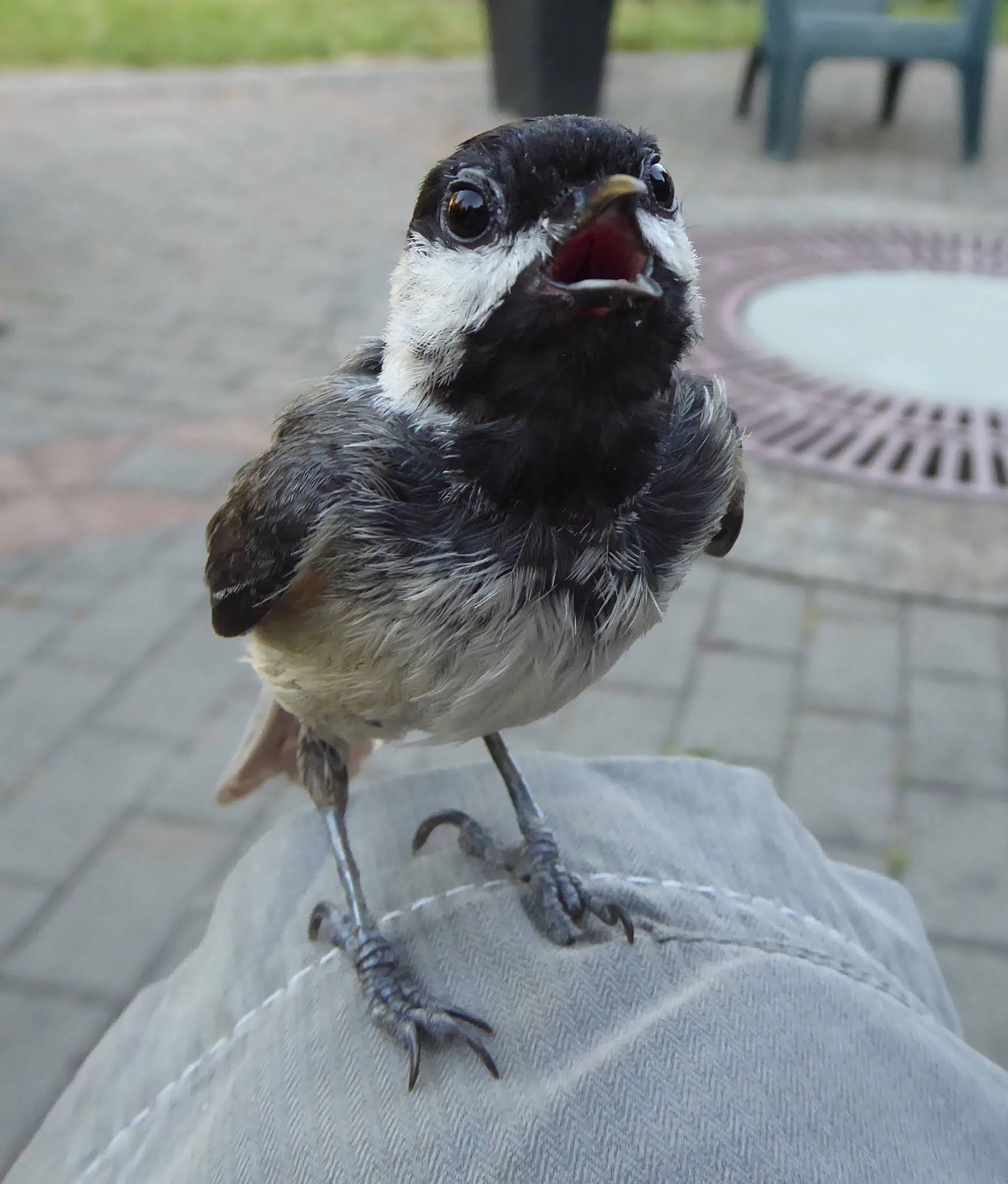
I got the only Christmas gift I'd specifically asked for. I wanted to be able to feed Studley a Christmas worm. He doesn't show up every day. But on Christmas morning that angel came in from on high and chikketed at me from the window, and popped around to the back door for his worm. Studley Windowson was special to me even before he demonstrated that he knew me personally and was willing to land on me (and my friends) for larvae. That was because I could pick him out from all the other chickadees. The others are every bit as worthy, but only Studley is missing two toes on his left foot. And caring about Studley leads to caring about his kids, and his food, and the native plants his food lives on, and his whole, world-wide web.

Meet Dot
Last week I was looking at lesser goldfinches on the feeder. They're flockers. Six years ago I didn't even know they were a thing, and now I recognize them as among my most common visitors. I know the sounds they make and I know how incessantly and adorably they make them. The other day I noticed one of them had a white spot on her head. I didn't know if someone had pooped on her--I mean, that has to happen sometimes, right?--so I paid attention later, and sure enough, she kept coming by, and it's definitely part of her feathers. Dot! Now I can pick Dot out of a big chirpety bundle of birds. I can tell how she approaches the feeder a little differently, and which azalea branch she favors. I have a new bird to care about. I can care about Dot, and thus even more about the rest of her flock, and second by second my caring can expand until it fills up the whole world. It starts somewhere.

In one second, a boy soprano can lift the top of your head off and send it to the stars. In one second, as you wait out the exquisite tension before a chord resolves, you can feel that ache pulled right through your heart and come out clean on the other side. In one second, you can really notice a bird. You can love any little thing. And then you know how to love the whole world. And that will cause you to change your life faster than any resolution will. 

We can all do it together. We can start anytime.

Wednesday, April 8, 2020

Push Pause

Don't waste this.

This: this experience we're sharing as a species is a rare opportunity. To pay attention. To notice. What do you feel? Let's start with something easier. What do you hear?

It's quiet where I am. I walk in the middle of the street to keep my distance from people and hardly ever have to get out of the way of a car. Traffic is mostly gone. I don't even hear many airplanes and we live near the airport. That quiet is the sound of fuel that doesn't have to be used, of trips that don't have to be made. How many of our trips really had to be made, before?

Are you able to work from home? More and more people can. If they can now, is there a good reason to commute later? Are all the conferences and meetings in person necessary, or even desirable? One person I know has been surprised to discover he's getting more work done from home.

Are you counting squares of toilet paper? Are you wasting less food? Are you thinking of putting in your first garden? What happened to all the toilet paper? Did everyone just suddenly shit themselves? How scared are we?

Are you frightened? Stressed? Don't waste this moment. Let it tell you who you are and what you're afraid of. Dying? What changed? You were always going to die. All that busyness you engaged in before--was it just to distract you? Pay attention to your fear. Notice it, and move on to something else.

What are you thinking about? What does it sound like in your head if nothing is distracting you? Do you imagine you should be getting a lot of stuff done now? What if there's nothing at all going through your head? Would that really be a bad thing?

What can you not do without? Why? Listen to yourself.

People are complaining about something they call social isolation...on the internet. They are discussing their loneliness with friends and strangers all over the world, all at once, all the time. They feel bereft. What happened? Not long ago, phone calls were too expensive to make often, or for long; we heard from each other at Christmas and once or twice a year by letter, if we were lucky. Friends, parents, children, everyone. It was fine. Not long before that, people would get in a wagon and go away from their friends and family basically forever. Now we are all rattled if we don't get our text messages returned right away. Are we better off for this? We're so tense. This super-connection: is it good for us? If you had to do without physical human contact, or do without the internet, which would you choose?

Do you feel compelled to read the latest about COVID-19? You want to keep up with the latest recommendations, sure. Then do you also need to hear and share everything you can about how dreadful Trump is? You already know how you're voting. Those people defending that sorry soul online are only going to keep you up at night. You can't spank them from your own device, and correcting their spelling doesn't have the sting you think it does. They don't care. Leave them alone. They're keeping you from paying attention. From noticing.

So do that. Go outside. Don't take any devices with you. Write a list for a scavenger hunt. Nothing is funner than a scavenger hunt! I'll start you off. Find an insect you've never seen. Find a bird. Find a bird carrying sticks and follow that bird until you know where it's going and what it's doing. Find something on the underside of a leaf. It could be on the ground, or still on the plant; turn leaves over until you find a spider, a gall, a fungus, a bug, a salamander, a larva, life. Find something natural that is sphere-shaped. Find a feather.

Find a drawing of anything, or even a doodle. Done by you. Earlier today.

Find the thing you're most afraid of. Stare it down until you're bored with it. Until it gives up on you and passes by. Live.

All these photos were taken in one twenty-minute outing in my yard, just after I finished typing this up. This is the first day I've seen crows with nesting material, and I've been looking. And then Studley showed up when I was trying to get a photo of a bumble bee. He wrecked that. All my bee photos were out of focus. If I had worries, I completely forgot about them.

Wednesday, February 7, 2018

Tales From The Zymoglyphic

Jim Stewart is a lucky man, but not just because he has a Root Worm living above his garage. This is Portland. People are pouring in and rents are unaffordable and a lot of folks are falling through the cracks, and if you have a room above your garage, odds are you're going to get a Root Worm in it sooner or later. And all of its friends.

Mr. Stewart is the chief instigator of the Zymoglyphic Museum, located in a room above his garage, in which are displayed numerous examples of artifacts from the Zymoglyphic region, such as that root worm. In fact, Jim probably has a corner on the market. The Zymoglyphic region exists at the intersection of the whole world and the space between his ears. He apparently began collecting museum-worthy items as a boy, and the discovery of glass eyes and glue set him on his current path. The thing about the Zymoglyphic is it's real easy to overlook, for most people, until you start noticing it. And that's what makes Jim lucky. Noticers are acquainted with joy.

He's lucky because he can go anywhere and find Zymoglyphic curiosities, and most people can't. Some people can get a little bump out of life by trolling the thrift stores for salt-cellars, or tin boxes, or thimbles, giving them that narrow but true joy of the collector, but Jim is a generalist. Which makes his joy broad in the beam.

I remember going on scavenger hunts when I was a kid, and it was a gas. It's hard to understand why it's so exciting to find and check off the items on the list--a feather, a rubber band, a clothespin; after all, many of us spend large parts of the day trying to find crap we know we put down somewhere and we can get pretty cranky about it. But scavenger-hunt items are random and irrelevant to anything but the hunt itself, and it forces us to look, and to see. To notice.

We have wonders all around us, yet many of us maintain a tedious existence merely by failing to notice them. Noticing is a habit we can develop, though. That's what birders do, after all. These are merely people who have learned to pay attention to what is all around them, and any minute, anywhere they go, a choice rarity might drop by. Feather! Rubber band! Clothespin! If you're not somewhere with a lot of birds around, you should really move. It's not good for you.

Wandering Burial Urn
Unfortunately, many people believe it costs money to enjoy yourself, and what with one thing and the Republican party, that means they're out of luck a lot of the time. But the best things in life have always been free, and certainly everything in the Zymoglyphic museum was. Dioramas of creatures from the Age of Wonder; conglomerations from the Rust Age; all Zymoglyphic artifacts began as noticed objects, requiring some assembly and reanimated by intuition. Here's a fungus that is lacking only its eyeball; there's a swashbuckling lichen two seed-pods and a leaf gall away from full sensibility. When you're scouting for your museum, you're not wondering what's wrong with your knee. You're not worrying about the performance of your portfolio in a downturn. You're alive. You're curating your own enthusiasm.

And in the Zymoglyphic Museum, even the dust is archival.

Saturday, April 28, 2012

Noticing

Most people look at birds with a hazy benevolence. They appreciate the robins and cardinals for being recognizable and they wish the other birds would announce themselves too, but unfortunately they remain brown and indistinct and hidden in the shrubbery. Some birds will helpfully tell you who they are, like the chickadee, but others, like the red-winged blackbird ("pull on my PEE-ter!") will not. It takes a birder to sort them out.

Me and Kelly, 2010
And most people have nothing against birders, but think, somehow, that their obsession is sort of trivial and dorky. But the only thing keeping most people from being bird dorks is the ability to see the birds. I once witnessed the transformation myself. I met my friend Kelly at the New River Birding And Nature Festival, true, and so I assumed she was fond of birds, but it was not a fully fledged fondness at first. Mostly she had a fondness for her wife Sara. (Everyone does.) We were both on the introductory field trip, and the guide had pointed out a beige flittiness in the branches above. And then he instructed us to--pay attention here--keep looking at the flitty area while bringing the binoculars up to our eyes. Well! I'd only been using binos for fifty years at that point without having that particular piece of information. It should be obvious, but many people, such as myself and Kelly, locate movement in the treetops and then look down to make sure we get the binoculars on our eyes and then look back kup to scan the tree with them, trying to find the movement again, to no avail. It's like shooting the Hubble telescope into space with a wobble built in and hoping a nova will sail into view.

A Cuteness Bomb
So it turns out that people of ordinary intellect can indeed lift binoculars in place without missing or stabbing themselves in the eyeballs with them, and then what do they see? Why, they see cuteness bombs going off all over the canopy. The flitty thing resolves into a blue-gray gnatcatcher pasting together a teacup nest out of lichens and nearby is a by-God tufted titmouse with a perky tiara and an orangey spot on the side and a black nose and a button beak and way over there is a mossy pendulous nest like a giant green scrotum and just like that Kelly and I are birders, complete with squeaky noises and zeal. Kelly instantly began rabbiting around the landscape like there was a whole skyful of news and she was behind in her reading. Fly as they might, those birds were not going to escape her and her newly useful binoculars. All it takes is noticing, and all that takes is binoculars and, for people without a grasp of the obvious, a sensible lesson in using them.

Once I'd come back home an accomplished noticer, Dave set up a bird resort right outside my writing room. There was a chickadee house, a suet feeder, and a hummingbird feeder within a yard of the window, and now, instead of staring into space while not writing, I could look at birds while not writing. I got regular visits from jays, a flicker, a gang of bushtits, and hummers that will happily kick every one of their asses for them. Two chickadees started hanging out a lot. They looked identical, but now I was a noticer. One of them, Studley, had a lower voice and seemed a little more aggressive, tidying up the suet feeder by scraping bushtits off it. Studley and Marge began bringing grass to the house and dumping it inside. (I learned later that they were making a mattress.) One day Marge wouldn't leave Studley alone and finally caught up to him and did something to his rear end that I would never have expected of Marge, and went a long way toward explaining why they never answered to their names. It only took a few seconds and then Studley retired to the house and a couple weeks later both Marge and Studley were hauling in grubs and bugs at the rate of 500,000 a day and evidently they made baby birds out of them, because that was the next thing that came out.

That's all a birder is. A noticer. The more you notice, the more you care. The more you care, the more you love. The more you love, the happier you are. My gratitude goes out to Jeff Gordon, the president of the American Birding Association, for showing Kelly and me how to spot birds with our binoculars, and waiting until we were out of earshot before laughing at us. Try it yourself. Because the little feathered buggers are everywhere, zipping all over the planet like valentines from God, and most of us are acting like we've got more important mail coming. But we don't.

My friend Julie Zickefoose is a virtuoso noticer and the proprietor of eighty acres of bird joy on the hem of Ohio. If you want to see how happy you can get just by paying attention, have a look at her luscious new book, The Bluebird Effect: Uncommon Bonds With Common Birds. You'll be plumb inspired.