Showing posts with label feathers. Show all posts

Wednesday, September 16, 2020

A Bird On The Side


A lot of you have discovered birds since you've been holed up at home, locked down with your mandatory family people. It's a natural step. "I'm going to look at birds," you say, on your way out the door, having run out of other pretexts, and nobody minds seeing you go. And then you're out there. Might as well look at birds.

I was already looking at birds. What I'm doing for fun now, a half-year in, is looking at really ratty-ass birds. Jeez, they look sorry. Some of them, like the crows, seem to be properly embarrassed by the state of their wardrobe. We have a house finch with two unshed old feathers sticking up on her head like horns. What a crew. Patchy-bald and tufted as a sprouted potato: a lot of them look like an old weedy parking lot. You won't catch me looking like that. As long as I stay indoors.


All right, I'm no prize either. I'm told I can get a haircut now without worrying about being dead in a month, but I haven't done it yet. As a result I can now put all my hair in a ponytail again. Not the sort you might see on a pony--we're more in toilet-brush territory. I could scour out a roasting pan with it, maybe.

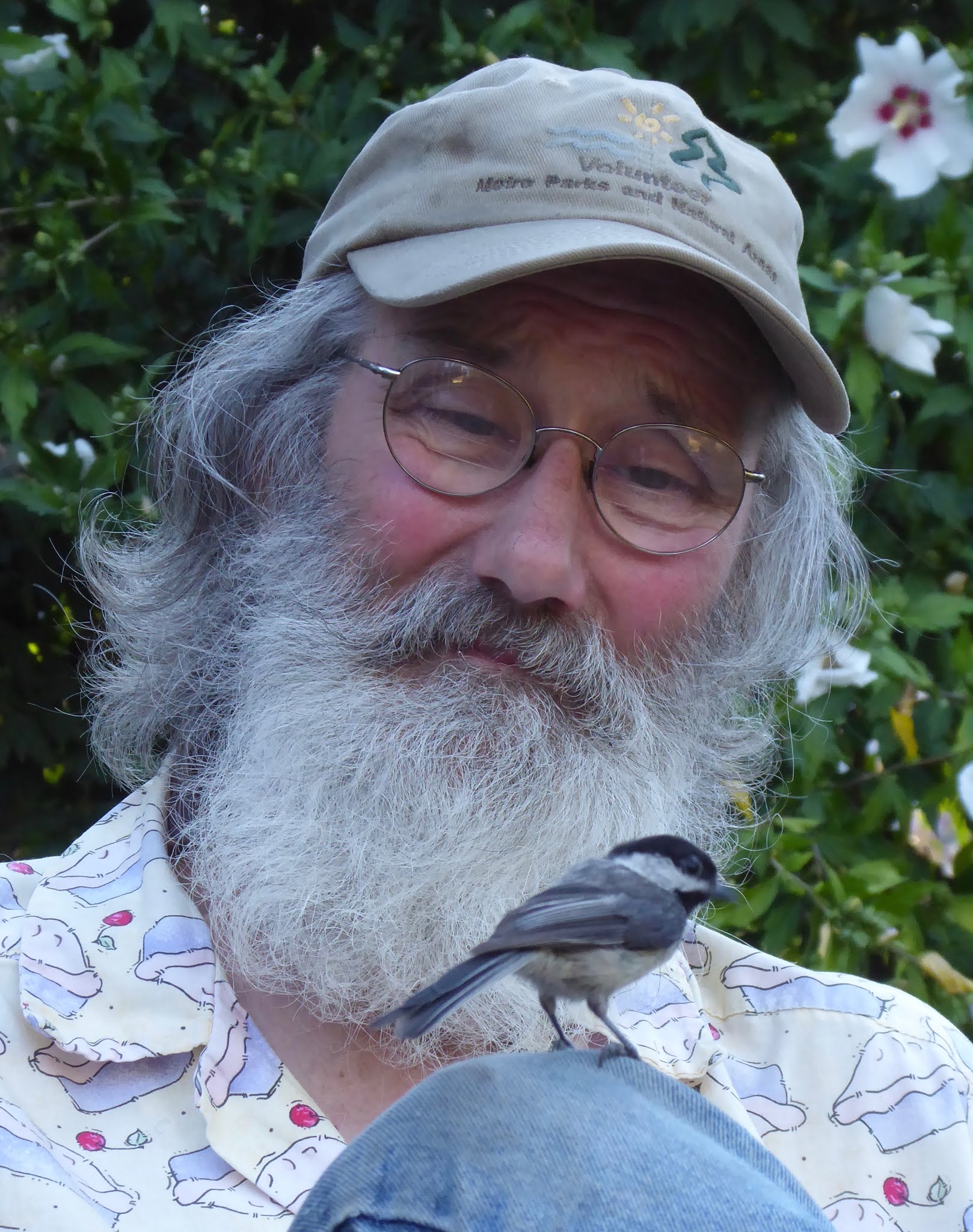
Studley Windowson, my chickadee, though not vain, is not coming around like he used to. He's good for a couple mealworms a day and thank you very much, but he isn't stalking us at the window or leaving long whiny voicemails. His kids are on their own.

I must here report that Marge and Studley got a second brood going, in July! I'm not kidding. I looked it up and they're totally not supposed to do that, but Marge must have been impressed with his prowess as a mealworm provider--our little secret--and sure enough that nest box was peeping again. And little diaper sacks were coming out of it. But fully realized birds? I never saw a one, and can't report that this batch was a success. And yet. The Studmeister! What a neat bird.

And I wouldn't want to do anything to hurt his feelings, but here's the deal. The Crow Project of at least ten years remains a bust. Dave has done his best to entice a personal crow and gotten absolutely nowhere. Our crows do not give one goopy shit about us. Everyone on the planet of any spiritual worth has their own crow but not us. However. Their cousins the scrub jays are looking like contenders. They like peanuts, and we have peanuts. We're tossing them ever closer to us with some success. They're still cautious, unlike their relatives, the gray jays. If you go into the high woods emitting so much as a cookie molecule, you will shortly be encrusted with gray jays. We think our city jays are coming around, though, and it's fun to watch them dart in and blast off like little jet-powered tyrannosaurs. They are superb at hopping, and watching a good hoppity bird hop is a sure cure for the COVID blues. 

Problem is, I don't want Studley to see me doing it.


Studley hates jays. I hate jays on Studley's behalf. I wouldn't even look at a jay after the Nuthatch Fiasco of Ought-Sixteen. Scrub jays act like they have no enemies (or peers). But the other day a bunch of them detonated out of the neighbor's plum tree followed very closely by a hawk. That probably cheered Studley up no end. Take that, screech-heads!

But, you know? The screech-heads are fun to watch. And I know my chickadee. I can pick out his tiny little chip-note anywhere on the block. It sticks out like an errant apostrophe. I listen, I wait, and when the punctuation is right, down goes the peanut. Don't tell.

Saturday, August 1, 2020

A Bad Feather Day

One thing that brings us together in a time we're all supposed to stay apart is we have something in common. We all look like shit. I had finally figured out exactly what length hair I should have, after all these years, and now it's galloping away again and I'm on track for being one of those old stringy-haired hippie ladies. That's okay. I've had decades of practice looking like shit and this sort of thing doesn't ruffle my feathers much anymore. And nothing is going to be done about Dave's hair until we fix the string in the weed-whacker. Also, we need to wait until we're sure nobody's nesting in there.

For a number of people who are not accustomed to looking unkempt (or, gasp, gray) it's an eye-opener. But we're not alone in this. You should see the birds.

Lots of folks are seeing the birds now, and wondering where they all came from. They've been here all along, of course, but only now got your attention. So take a good look: because a whole lot of them are in a state of major disrepair. Which makes them even easier to relate to. The scrub jays aren't used to humility and seem to have lost a little of their verve. Their screeches of menace have gotten a sour lilt to them, more bad attitude than triumph. It used to be Tremble before me! Prepare for thy doom! and now it's more Oh yeah? Something-something your mother, you'll be hearing from my lawyer. The chickadees are too busy to get worked up about how they look. But let me break it to you gently. They look bad.

Really bad.

Feathers are super important for a bird. Most of what they're good at would never happen if they were naked. Flying, staying warm, looking hot for the ladies, it's all about the feathers. Your feathers go to shit, you will soon follow. And feathers wear out. So once a year, or twice for some species, they have to swap out the whole outfit for fresh.

Ducks make a clean sweep of it. Waterfowl in general just drop everything at once and head into quarantine in the middle of the pond until they resprout. Ornithologists like to say they do this to stay safe since they're not able to fly for, like, a whole month. But shame and humiliation could explain it just as well.

The rest of the birds re-up their feather complement more methodically, a few at a time, so they can stay in the air. From the hummingbirds to the crows, everyone's a mess. They're rumpled and linty. If the same thing happened to my sweater, it would skip right past the Goodwill pile and go under the sink with the Lemon Pledge.

I thought I was prepared for Studley's molt. Last year he had a bald spot and patchy cheeks. But this year I was shocked. That vulnerability of baby birds in their pink-goobery stage has always frightened me, until they grow up and develop spark and substance. But it turns out that the right bird outfits, just like ours, can hide plenty. And Studley, poking his head up and around, has revealed that there's not a lot of bird there. He's still a goober with fluff, until the fluff falls out. Please, please, Studdles, feather out! I need the illusion of solidity. I need to imagine you can't be clotheslined by a strand of spider silk. Lordy, dude.


Saturday, September 21, 2019

The New Wardrobe

I told you about our chief chickadee Studley Windowson and his new duds. The boy is all freshly feathered out for the next year. What is a feather, anyway? Feathers are the fanciest thing you can make out of keratin, a protein. Not you personally. All you can do is make sparse and peculiar outgrowths of hair, ratty fingernails, and dandruff. We humans might dye our keratin or paint it but we don't make magnificent spiraled horns out of it or anything as spiffy as feathers. We have to compensate for our feeble keratin skills with art, music, and certain kinds of comedy.

Or by swiping feathers off a bird that wasn't done with them and sticking them on ourselves. Historically, nobody waited for the feathers to fall off the bird, but instead plucked the animal, such as the egret, nearly into extinction, which is a shame, but damn, the hats were fabulous.

Keratin isn't living tissue, which is why you can, if you have a super nice cat, clip her claws more than once. But because it isn't living tissue, it can't renew itself when it gets worn out. So the feathers fall off the bird periodically and the bird starts over.

Once you've made yourself a feather, you'd best take good care of it. You have to preen it, and nibble at it, and straighten out the little interlocking side shoots off the shaft, and keep it in good condition, so you can fly properly or repel water or stay warm or whatever you need your feathers to do. But eventually there's going to be some wear and tear. And so, the feathers will have to be replaced by brand new ones. A warbler that never molts will end up being a sad little golf ball with bristles and stubs, just parked on the ground waiting to be someone's lunch. I assume. It doesn't happen.

Some birds molt once a year. Some birds do a half-assed job of it once a year and a whole-assed job later. Only a few do a complete molt twice annually, and those are the ones that really beat up their feather allocation by flying through windmills. Ha ha! Not really, just dense vegetation and such. The birds that fly through windmills quit molting altogether.

Studley is a once-a-year man and as such he looks as good now as he ever has or will. Some birds drop all their feathers at once, such as your duck, who is then temporarily flightless and moves to the center of the pond and tries not to get nabbed by anything, which is why it's called a "duck." (The goose has the same issue but knows how to defend itself, which is why it's called a "goose," and you shouldn't turn your back on it.)

But most birds are more methodical. They'll drop their feathers and replace them in a particular order and that way they can stay in the air, if they've a mind to. Crows in August show grand gaps in their wings and tails but they're never actually grounded. They're a little irritable though because they're vain and they know they look like crap. They'd totally make egret feather hats if they had the materials.

For many birds, the sexes are differentiated by their outfits, and many also look different as babies than they do as adults. A particularly annoying form of bird looks different after every molt for several years in a row. This is utterly fine if you are a talented birder and can squint at a distant dot and confidently (some would say arrogantly) mark it down as a three-year-old herring gull as opposed to, say, a two-year-old herring gull, a junkyard scrabble-pigeon, or an eye floater. Gulls in general earn their keep in the birding world by being difficult to identify but theoretically solvable. Normal people can get back at birders by calling all these birds and their distant kin "seagulls," which drives birders crazy. Keep that in your back pocket. They'll correct you, and you'll just shrug at them because you don't care. They'll feel superior and impotent at the same time, sort of like liberals.

But that is all just one more point in favor of Studley and his cohort. Not only do Studley and Marge look alike, but they stay alike all year long, and produce children that look just like them. That, there, is a considerate bird.