
Showing posts with label amphibians. Show all posts

Wednesday, March 9, 2016

The Voices

What I intended to do was park my fanny in front of the TV with a beer and watch The Voice. Don't judge. I like The Voice. You don't approve of that, find yourself a classier blogger.

However, my plans were dashed when the temperature rose and the weather turned drizzly mid-afternoon. That's not TV weather. That's frog weather.

For three years now the members of the Harborton Frog Shuttle have been ferrying frogs and salamanders across Highway 30. The amphibians live uphill in Forest Park and the place they have their Spring Mixer and Cotillion is downhill, below the highway. This has resulted in a situation that brings tender-hearted drivers to a screeching halt to sob against the steering wheel. Unfortunately, there aren't very many of those drivers. It's a squishfest. Rob Lee, who lives at the junction of Frog Lust and Highway 30, decided to do something about it.

It's pretty low-tech. Assemble an army of frog wranglers and give them buckets. We pick up the frogs, put them in the buckets, drive them across the highway, and decant them into the swamp. Our chief concern is for the charming Red-Legged Frogs, which, like a lot of other critters, are in some trouble these days. But we'll scoop up the tiny Chorus Frogs too. They're not listed as endangered, except in the sense that they're going to turn into paste on Highway 30, and that's endangered enough for us.

Long-Toed Salamander getting a ride
They're surprisingly easy to catch. It's possible that recent generations of frogs have internalized a collective memory of Highway 30 and they're not all that anxious to cross it. So when they're on their way and someone stands in front of them with a bucket, it strikes them as being a fine time to take a breather.

There are a lot of things that look like frogs when you're wandering around in the dark in the rain. Rain splashing off the pavement looks like small hopping frogs. Stranded clumps of lichen look like frogs. Your more charismatic leaves look like frogs. Water droplets on the grass look like frog eyeshine. You know what really looks like a frog? A frog. You get good at it after a while.

Last year our efforts were less effective and more fun. Aerobic, even. On a good warm, wet night, we were dashing all over the place trying to bag them all. This year, our intrepid frog captains have rigged up fencing with landscape cloth. It's nothing these frogs can't surmount, really. Half of these guys have been mounting everything in sight for weeks now. But it is a puzzlement at first. They poink up to the fence and sit there and say "Huh." And we collect them like so many dimes in the sofa cushions.
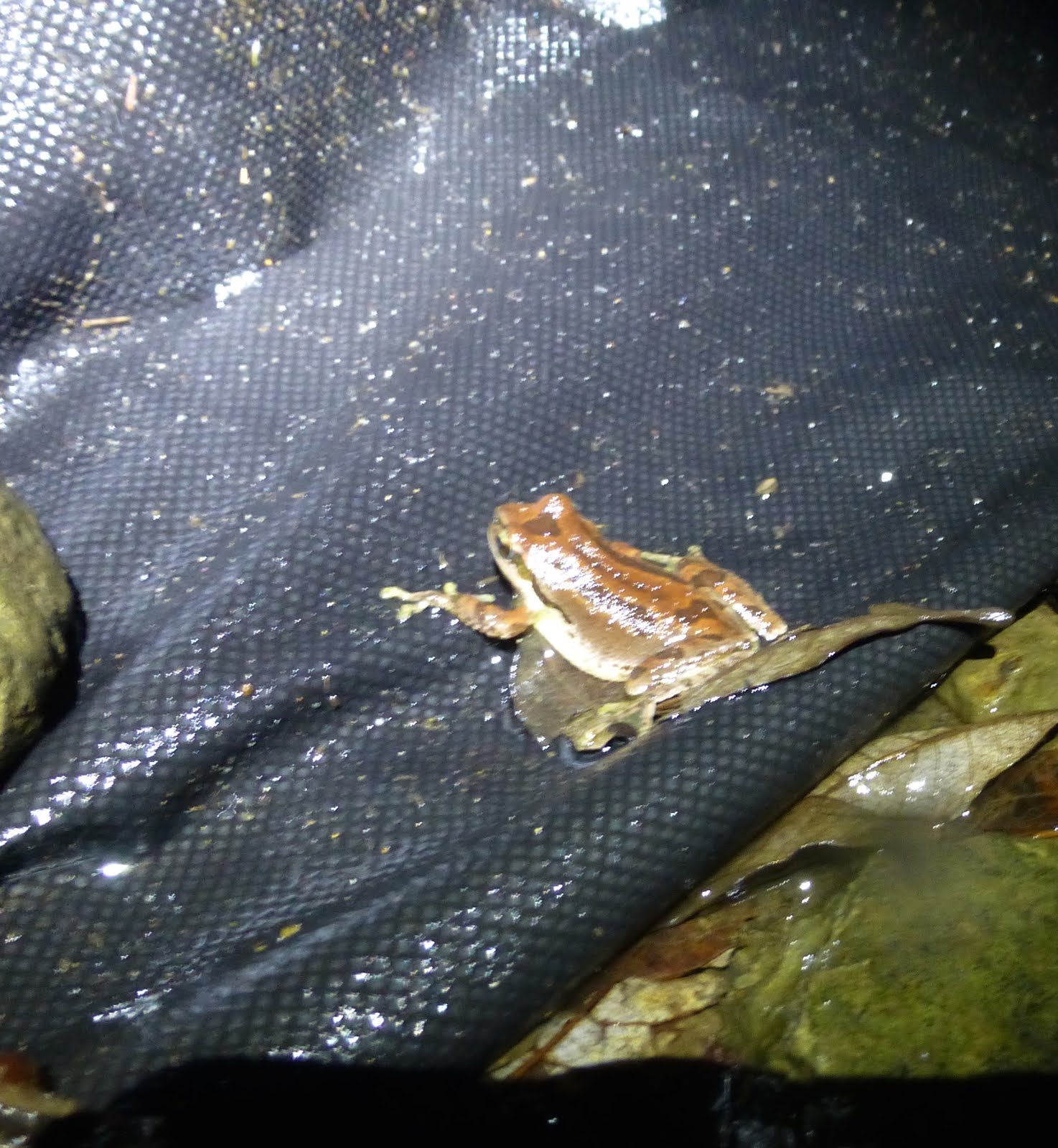
In the first part of the season, all the frogs are coming downhill. It's easy to tell the sexes apart. The female red-leggeds are much larger to begin with but they've also let themselves go. They're plump with eggs. They're gravid; the males are avid. Boy howdy they're avid. They're motivated. They're fast. Of course they don't have to deal with bloat. On the way back up it's a little harder. Presumably you can tell the males because they have swollen, let's say, thumbs, but frankly you can tell the females also because, not to be indelicate about it, they kind of have stretch marks.

Yes, at a certain point many of the frogs start heading back uphill from the swamp. And that means we have to intercept them below the highway. There is a considerable number of weeks that we'll have frogs going both directions. Sometimes we're not sure which way they're going. We have to conduct an interview right there in the street.

The red-leggeds make almost no sound at all. If severely provoked, they sort of mutter "Hey, now." And there's a little thumping sound when they, ah, kick the bucket. But that's about it. Still, the swamp is crazy with frogsong. That would be our chorus frogs. The little buggers are total belters, every one. Right on pitch and no affectations. You're not going to find that on TV.

Wednesday, May 6, 2009

Wade Bogs, Continued


March 21, 2009. The forecast was rain, hail and thunderstorms. Obviously it was time yet again for my niece Elizabeth and me to go out and fulfill our sacred trust as Official Amphibian Egg Mass Monitors for the regional government. Earlier forays had had middling results, but now we were shiny with authority, proudly sporting our solid bronze Official Amphibian Egg Mass Monitor badges, thanks to Mary Ann.

We set out under a suspiciously sunny sky. Team Brewster was newly energized after a pep talk from the big Frog Egg Boss, Jean Lea. Four egg masses, found previously, were not to be pooh-poohed, she told us, and when we had time to think about it, in the two weeks since our last outing, they had been particularly lovely frog eggs. Plumper and more life-affirming than your average egg masses, and if you leaned in real close, you could almost hear little tails trying to sprout out in their little jelly sacs. This time that bog was going to be crazy with eggs. It had been drizzling more or less constantly for days and days, and a bit warmer, and sure enough, when we arrived at our assigned patch, it was wider and wetter and rollicky with frog song. I planted a boot in the mud on the edge, planted my hands on my hips to admire the scene, and slowly fell on my ass without further ceremony. We were ready to roll.

We set up a wading pattern and trudged carefully into the chilly swamp, eyes sweeping back and forth like pendulums, and encountered the usual issues with floating vegetation we couldn't see through and muck and weeds that grabbed our feet and threatened our verticality. But it wasn't until we'd been in an hour and were up to our waists that half of Team Brewster went under. It wasn't the half I was in, so I found it rather comical and may not have reacted properly. Why are you sitting down? I thought. Why are you making those squeaking noises? I thought. the masks of comedy and tragedy are closely entwined. The younger half of Team Brewster surrendered the clipboard and spoon and wailed tragically towards the shoreline to mop up, strip to underwear and decant the bog from her waders, which, to my surprise, she was able to do even without the instructions being printed on the bottom of the boot. After a short interlude she discovered, to the surprise of both of us, that she wasn't going to die after all, and gamely came back in the water. Shortly after, we were rewarded with an egg mass. We were so excited and overcome that we completely forgot the four items we needed to check off on our clipboard, even though the directions were written down thereon, and flapped and hoo-hooed and generally proved completely useless for five minutes or so. Team Brewster had a fatal flaw. It's the same flaw that is rumored to crop up in tiny isolated hamlets in the Ozarks. Briefly, it had too many Brewsters in it, and not enough moderating personalities.

Many people have found Brewster girls entertaining over the years. They watch in amusement as we tip over for no apparent reason, and make pronouncements that suggest our beads have come unstrung. But we were not designed to operate on our own. We require an anchoring influence. We need people who love us and care for us and set us back upright. We make great pets.

We're probably just average Amphibian Egg Mass Monitors.

Wednesday, April 1, 2009

Wade Bogs


My niece Elizabeth and I were ready to set the world of amphibian egg mass monitoring on fire. It's a small world, but we're a small flame. We are among eighty or so volunteers checking on the health of local wetlands by locating and recording frog and salamander egg masses. We got our personal swamp assignment from the Big Frog Egg Boss, Jean Lea, and we were rubbered up and ready to wade. Hoo-yah! Team Brewster was on the march. We were familiar with the plan: wade your bog in a straightforward, methodical grid, taking care not to stomp the eggs or stir the murk, and flag all egg masses found. We were pumped. Jean Lea met us out at our site and waved in the general direction of what appeared to be, at most, a damp spot. "It doesn't look that big," I noted, to which she replied: "Well, it's deceptive."

An hour later I was up to my nipples in deceptive. Admittedly, this doesn't take as much water as it did ten years ago, but still. It was nearly impossible to wade the site methodically. Where we had envisioned a nice square Colorado of water, we got New Jersey. The margins were thick with willows and nearly impenetrable. We peered in as far as we could, but saw nothing. In the more open water, we were quickly within an inch of flooding our chest waders. We had at it from numerous angles, crawling through a barbed-wire fence and whacking through blackberry vines, and everywhere it seemed to call for a kayak or at least much taller amphibian egg mass monitors. I found myself fantasizing about the sites that had been assigned to other monitors. They looked like football fields; in my most despairing moments, they even came with yard markers to make the grid-walking easy as pie. Had we been sent on a snipe hunt? Was Jean Lea trying to drown us? Had she been informed that we had no progeny, and that once Team Brewster was gone, the world would be rid of us?

Worse, we had seen no egg masses at all. It was possible that they had not yet been laid, but we couldn't rule out that we were just the worst amphibian egg mass monitors ever. Self-doubt reigned. And then we saw them. Four massive blobs of red-legged frog egg jelly, green with algae and speckled with future tadpoles like an illustration of the meaning of life. Could anything be jollier?

The Northern Red-Legged Frog lays her eggs with the help of her smaller mate, who, according to the froggy manual, grasps her about the waist and squeezes. This in itself is romantic, because although the frogs are undeniably beautiful, they really don't have waists, so much, or not by our standards. But they might like to think they do. Part of romance involves shading the truth a little. It's sort of like when Dave and I were in the Louvre and he observed that the Venus de Milo's rear end reminds him of mine. This doesn't have much to do with the frogs, but I like to work it in whenever I can, and this post seemed like as good a place as any.

To be continued.
...........................................................................................................................................................................

Addendum: In an earlier post, I hinted broadly that it would be swell if we got official Amphibian Egg Mass Monitor badges. And my buddy Mary Ann Dabritz, an artist and unthwartable spirit, apparently agreed and promptly stepped up with this solid bronze beauty, which can be viewed along with a host of other amphibian art, and frankly, almost anything else a body could want at www.castofcharacters.com; there's a link in the left margin, under "Mary Ann's Astonishing Animalware."

Saturday, February 14, 2009

Morning Eggs


I don't know what you all did Tuesday morning, but I got up and went outside in a 33-degree mixture of snow and rain to stand in a swamp up to my navel and sample salamander eggs with a spoon. The precipitation was vintage Portland: first it clumps on your hat, then slides down your neck. Yes indeedy, so far, retirement is everything I ever dreamed of. There were about a dozen of us at this party, and we were being trained to be Amphibian Egg Mass Monitors for the regional government entity. They didn't bring the spoons this time, and we didn't get Egg Mass Monitor badges, but they did provide chest waders. These were all flung willy-nilly onto a tarp for us to pick out; it looked like a massacre. There were the standard rubber jobs such as a first mate on a salmon boat might wear, and there were also slick new neoprene models. I tried those.

It takes about ten minutes to shovel yourself into neoprene chest waders, especially without lubrication. They are quite slimming, when worn by a slim person such as our trainer, Jean Lea. Otherwise, they make you look like the love child of the Michelin Man. It is no cakewalk to pull them all the way up. It's like stuffing melons into a garden hose. You really need a tool. I have a new item in mind: it would look something like a thin tractor seat on a handle. I'm calling it a Heinie Horn. But the neoprene is toasty and dry, and might just protect against sexually transmitted diseases as well.

The idea is to survey a section of wetland in a measured pattern to determine how many egg masses have been laid. We're just looking for red-legged frog eggs and northwestern salamander eggs, because they're huge and bulbous and easy to spot. A few other kinds of amphibians will have made some deposits as well, but their contributions look like something you might hawk up in the morning, and for our purposes we can ignore them.

Light conditions and turbidity affect our ability to peer through the murky depths, but on this day we also had a veneer of ice to contend with. However, it was no match for my trifocals and my zeal. I found one phlegm ball a foot deep, the output of a long-toed salamander. It didn't stand a chance--I've got skills. My daddy used to take me out to the swampy patches during spotted salamander mating season (this was even before Nintendo), and he'd take notes and photographs while I scavenged. Some people have been primed for a career in medicine from an early age; I was groomed for an unpaid position in hip-deep muck, like a lot of other people in this economy. Daddy would be a hundred by now, and he would have been so proud his youngest finally made something of herself.

The spoons supposedly make it easier to see and identify the egg masses, and we'll get our own spoon and stopwatch and a map to our own personal patch of swamp in a week or so. I'm still hoping for a badge, too.

Wearing waders reminded me of steelhead fishing. Steelhead are a mythical fish said to roam the cold waters hereabouts, but you never actually catch one, even wearing the good waders. Likewise, we found none of our target egg masses this morning. We're just a little early; the amphibians in question are holding off on a night of romance in the kind of temperatures we humans were willing to go out to look for them in. This just goes to show that evolution isn't always all it's cracked up to be. It's something to think about the next time you hear someone explain that we need to care about the health of the amphibian populations because they are indicator species, and their fate portends our own. No.

We care about the amphibian populations because they are worthy and handsome and noble of eye and spirit, and a credit to the planet. Really, the hell with us.