
Showing posts with label Northwestern salamander. Show all posts

Wednesday, April 10, 2019

All Hopped Out

It's early April and the frog-shuttling season is just about buttoned up.

There are over seventy of us humans in the Harborton Frog Shuttle, all ready to pop out on a nice wet night and scoop up frogs in a bucket before we'd have to scoop them with a spatula. They want to get to their wetland and make new frogs, and they have to cross Highway 30 to do it. God did not install Highway 30, and whoever did wasn't doing it for the frogs.

The season can be long. We're on the alert for downhill movement as early as November, but don't generally see much action until late December. By February we're ferrying frogs back uphill until we run out of customers, which is usually around the end of March. It seems like an onerous burden, but we split up into nightly teams, so we each need to keep only one night a week open on our calendars.

I'm the co-captain of the Monday team. That's not as fancy as it sounds. That means the five percent of the time the real captain, Captain Jane, can't make it, my sorry fanny is enlisted to gather the troops, locate the buckets and safety vests, apologize all night long if the frogs don't show, and possibly screw up the data log. But the Monday Nighters are forgiving sorts. The Monday Nighters rock.

Each of us has one eye on the weather report for four months and a pocket of our consciousness devoted to the well-being of our extended frog family. They're like any other kids. They don't like the discipline of the bucket, but we're grownups: we don't expect gratitude. We just want grandbabies some day, and all will be forgiven.

Most years we shuttle about 800 frogs. Last year we had only half that many, and a stone on our hearts. This year we were really excited. We scooped up over 1200 frogs early on! Only 90 of them were females, but that was expected. The males always dominate the early migration. They have enthusiasm. They have spunk. Great Gosh-A-Mighty, they have spunk. The females will be along later. They're bloated with eggs and they'll get there when they get there, Sparky. We awaited another warm, wet night and a deluge of females. And we waited.

...and a few freeloaders
But night after night, it was too cold. And when it wasn't too cold it was too dry. And somewhere around the middle of March, the males gave up. They started back uphill. The way-outnumbered females did too; they'd had it. It's looking like the worst season so far.

We don't know what gravid females do with their eggs if they can't get to a pond. We don't know if they're reabsorbed or if the ladies just have the world's worst period and bitch at the salamanders. We did find one doomed egg mass in a trickle of water along the highway shoulder. We don't know what to blame, except the weather. I'm perfectly willing to assign this little calamity to Mitch McConnell and Charles Koch, of course, and I can even draw a few straight lines to do it.

But I don't want those soulless monsters residing in my head any longer than I have to. That's where our frog family lives. We can't forestall the catastrophe that's coming, but we can improve the world one pink frog at a time, at least for a while. And so that's what we're going to do.

Wednesday, April 7, 2010

Woo Woo


I've seen a number of perfectly good amphibians in these parts, although not near as many as I'd like, but I've never seen a Northwestern salamander or a Northern Red-Legged frog. They're famously reclusive, and rarely bother to get out at all except on cool, rainy nights, which is when I'm watching reruns of House. My dad and I used to tromp the swamps in precisely those conditions looking for spotted salamanders in the spring, but that was an east-coast glory and I've gotten out of the habit here. Nevertheless I am confident of their existence because I am an official Amphibian Egg Mass Monitor with a badge and everything, and I have seen their bodacious egg blobs. (Using much the same logic, we can infer the existence of letter carriers by the appearance of Netflix.)

Both species leave large egg masses, distinguishable by their size (orange, grapefruit) on the Universal Citrus Scale, the same one used to describe fibroid tumors. The frog, in fact, puts out a mass easily three times its own size. It is a feat comparable to someone like me giving birth to a fully-formed Rush Limbaugh, covered in gelatinous goo and held under water for several weeks. Give me a moment...ah. All right, I'm back.

Amphibian sexual behavior differs from human in many ways, notably in the lack of penises and penis-related activity and advertising, and the males have to rely on attitude, romance and some really big thumb-pads. Cuddling and spooning play a big role. Amplexus refers to an ardent hug that can last for hours or days but does not require medical intervention. The Northwestern salamander (Ambystoma gracile) is the more gentlemanly of our two target species. He is the strong, silent type, and during courtship he rubs his chin along the female's head. He then deposits a sperm packet on the bottom of the pond, and his emission, should she choose to accept it, is picked up by the female to fertilize her eggs, which she attaches to suitable vegetation. A decorator is called in to festoon the egg mass with algae, and the young are hatched within weeks and ready to apply for college.
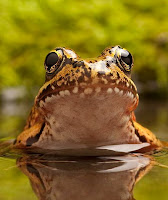
On the other hand, the male Red-Legged frog (Rana aurora aurora*), for a fellow without a penis, can still be sort of a dick. He will put an amplexus move on anything in sight, including fruit, Northwestern salamanders and other male frogs, so in that respect, he does resemble a human. When a male is clasped by another male, he emits a "release" call, unless of course he doesn't, not that Pat Robertson needs to know about this. Once engaged in amplexus with a receptive female, he sings a low-intensity note every second into the female's ear, audible only to her. Sweet nothings and the hug are his entire repertoire, and it seems to work most of the time. However, if a female is not receptive, she will sound release calls, stick her legs out straight and roll over repeatedly--again, startlingly similar to human behavior.

With both species, eggs are laid in shallow, still waters, such as a wetland pond, and it is important that the pond retain enough water to see the tadpoles through to maturity. Since many of these wet patches dry up by June, the animals have evolved to breed during a quite short season, which means most of them are Pisces or Aries. In contrast, humans are able to breed all year long, since their young in many cases remain in their parents' care for up to 35 years.


*Rana aurora aurora would be an excellent name for a girl. It sounds lovely, and if she comes home late and can no longer pronounce her own name, you can ground her.

Wednesday, February 24, 2010

Love Is In The Water


It's the middle of February, which can only mean one thing around here: it's time to jump into a cold swamp up to our nipples and look for evidence of amphibian romance. Yes, Team Brewster is once again gearing up to monitor egg masses of frogs and salamanders for the regional government entity in charge of wetlands. They won't know how good a job they're doing until we come back with some hard data. It's not always comfortable out there, but one neat thing about being immersed in a cold swamp is you barely notice the stiff winter winds.

Sadly, Team Brewster has lost half its members. Elizabeth, who keeps an overcoat on when she visits us, even if we have the heat jacked up to ninety for her, bailed out this year. Even after I offered helpful suggestions. "Quit falling in," I told her, but she was unmoved. I'll miss her, but there's a lot to be said for diversifying the gene pool a little bit. Brewsters have their good qualities, but none of them are all that useful. We're great at showing up, and tipping over, but don't look to us for direction. There have been Brewsters in this country a long time; the starter set barreled over on the Mayflower full of righteous fire and not much else, watched everybody drop dead the first winter, and had barely enough gas left over to procreate. Now, nine or ten generations later, we're still a sparse population of, shall we say, unusual intellects.

Fortunately, Dave has stepped up. Among his other fine traits, Dave does not confine his activities to the sensible. Plus, he has much higher nipples. He proved to be a natural right off the bat. I told him to look for egg masses that look like oranges (Northwestern salamander) or grapefruit-sized tapioca (red-legged frog), and, attuned to all things edible, he homed in on some right away. Everything stops at this point while we write down our data and flag the eggs. Elizabeth and I had trouble with this, juggling a clipboard, several markers, a spoon (don't ask), tape, a stopwatch, and a large bundle of bamboo sticks. It was always an ordeal. Dave starts right out by laying the bundle of bamboo sticks on the water.

"Bamboo sticks float?" I said. Well, don't that beat all.

Minutes later, he was working his problem-solving skills again, when he tried to determine if his waders leaked by farting in them and looking for bubbles. The man complains that his cognitive powers are slipping, but he has a long way to slide before he gets to the Brewster mental terrain.

Last year, our assigned patch of wetland was barely manageable for two monitors. It was a lot of territory. This year, same location, Walden Pond had been replaced by Lake Michigan. We're going to be at this a while, I thought. Meanwhile, Dave was hard at work.

"Whoa," he said, bending over.

"You got eggs?"

Dave nearly had his nose in the water. "Pretty soon," he said.

Whereupon he reached in and scooped out a pair of rough-skinned newts, locked in embrace. "Dude," you could almost hear them saying, but nobody was letting go of anything. The female was smaller and had the standard grainy skin texture, and the male was so engorged--all over,
mind you--he'd gone smooth. They can remain clasped together for hours or days, and sometimes a whole group of them are tangled together. It's called a mating ball--which isn't what we used to call it back in college, but we might as well have. We started to see them everywhere. We haven't logged too many egg masses yet, but there's romance in the air. It doesn't look like these guys are giving anything up for Lent.

It's still Muddy Gras in the old town tonight.

Wednesday, April 1, 2009

Wade Bogs


My niece Elizabeth and I were ready to set the world of amphibian egg mass monitoring on fire. It's a small world, but we're a small flame. We are among eighty or so volunteers checking on the health of local wetlands by locating and recording frog and salamander egg masses. We got our personal swamp assignment from the Big Frog Egg Boss, Jean Lea, and we were rubbered up and ready to wade. Hoo-yah! Team Brewster was on the march. We were familiar with the plan: wade your bog in a straightforward, methodical grid, taking care not to stomp the eggs or stir the murk, and flag all egg masses found. We were pumped. Jean Lea met us out at our site and waved in the general direction of what appeared to be, at most, a damp spot. "It doesn't look that big," I noted, to which she replied: "Well, it's deceptive."

An hour later I was up to my nipples in deceptive. Admittedly, this doesn't take as much water as it did ten years ago, but still. It was nearly impossible to wade the site methodically. Where we had envisioned a nice square Colorado of water, we got New Jersey. The margins were thick with willows and nearly impenetrable. We peered in as far as we could, but saw nothing. In the more open water, we were quickly within an inch of flooding our chest waders. We had at it from numerous angles, crawling through a barbed-wire fence and whacking through blackberry vines, and everywhere it seemed to call for a kayak or at least much taller amphibian egg mass monitors. I found myself fantasizing about the sites that had been assigned to other monitors. They looked like football fields; in my most despairing moments, they even came with yard markers to make the grid-walking easy as pie. Had we been sent on a snipe hunt? Was Jean Lea trying to drown us? Had she been informed that we had no progeny, and that once Team Brewster was gone, the world would be rid of us?

Worse, we had seen no egg masses at all. It was possible that they had not yet been laid, but we couldn't rule out that we were just the worst amphibian egg mass monitors ever. Self-doubt reigned. And then we saw them. Four massive blobs of red-legged frog egg jelly, green with algae and speckled with future tadpoles like an illustration of the meaning of life. Could anything be jollier?

The Northern Red-Legged Frog lays her eggs with the help of her smaller mate, who, according to the froggy manual, grasps her about the waist and squeezes. This in itself is romantic, because although the frogs are undeniably beautiful, they really don't have waists, so much, or not by our standards. But they might like to think they do. Part of romance involves shading the truth a little. It's sort of like when Dave and I were in the Louvre and he observed that the Venus de Milo's rear end reminds him of mine. This doesn't have much to do with the frogs, but I like to work it in whenever I can, and this post seemed like as good a place as any.

To be continued.
...........................................................................................................................................................................

Addendum: In an earlier post, I hinted broadly that it would be swell if we got official Amphibian Egg Mass Monitor badges. And my buddy Mary Ann Dabritz, an artist and unthwartable spirit, apparently agreed and promptly stepped up with this solid bronze beauty, which can be viewed along with a host of other amphibian art, and frankly, almost anything else a body could want at www.castofcharacters.com; there's a link in the left margin, under "Mary Ann's Astonishing Animalware."