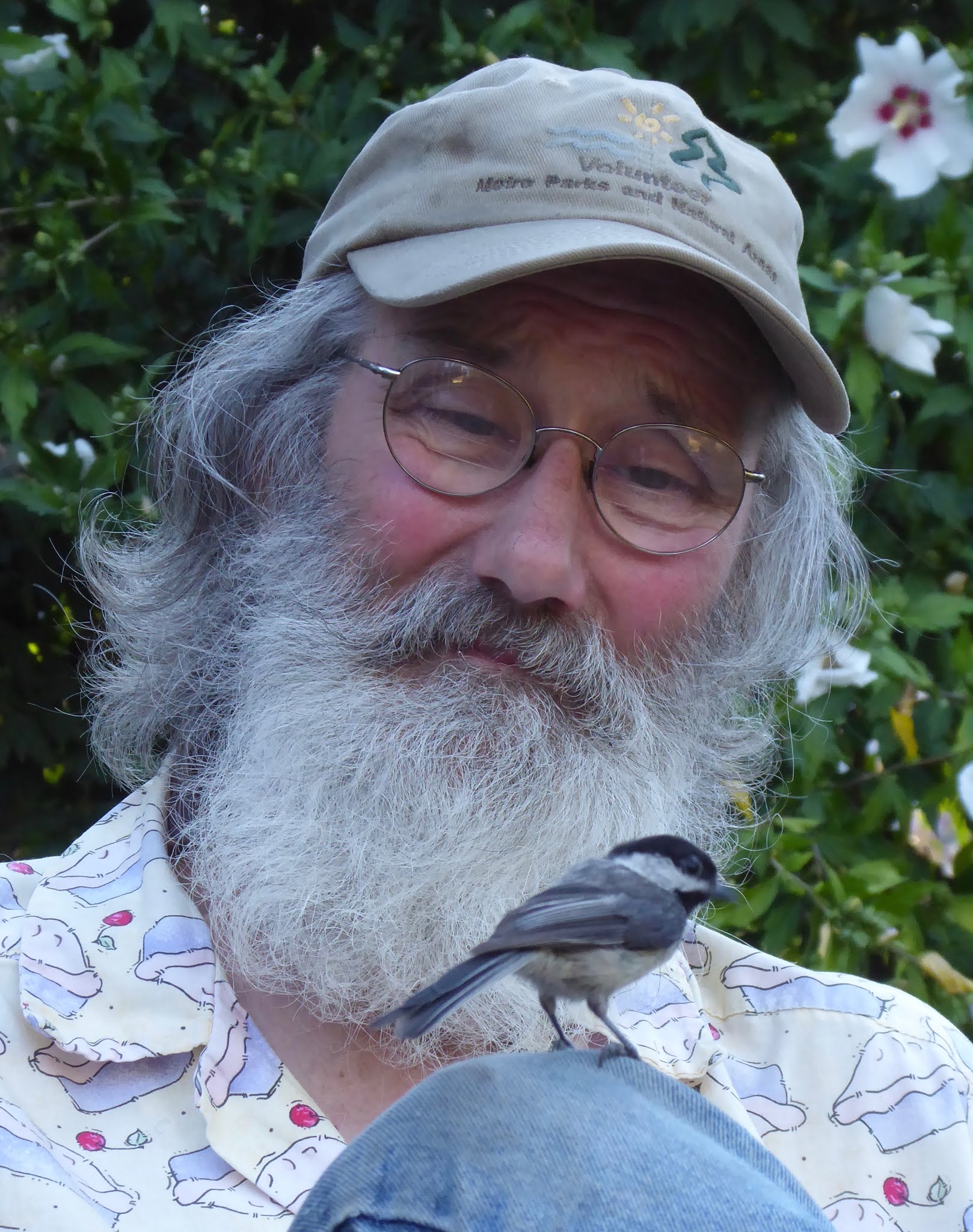

Showing posts with label molting. Show all posts

Wednesday, March 10, 2021

Moltin' Gold


Sometimes my mom would snatch me by the arm as I was barreling past to go outside, and say "Hold on. You look like nobody loves you." Then she'd scrub my face with a washcloth and punt me out the door. It made me all squinchy and I thought it was uncalled-for but I did absorb the fact that she cared. Dave says his mom did the same thing, only she'd pull a Kleenex out of her sleeve and spit on it, for extra love.

The thing is, when you love someone and feel some responsibility for them, you do pay attention to how they look--whether they're healthy, or presentable. And that is why I have been acutely aware of every feather on my personal chickadee Studley Windowson. As Yogi Berra might have said, you can observe a lot just by looking. And Studley lets me have a real close look, several times a week.

I've learned so much. But I'm not breaking any new ground. Other people are already on it. My friend Julie Zickefoose, the queen of noticing, l'arned me something new just the other day. I had observed that my chickadees take one seed from the feeder and go off to a branch to work it over, and that the goldfinches didn't, but I didn't know why. Turns out goldfinches aren't able to hold a seed in their feeties like the chickadees. Now, I'm not sure that puts the chickadees at an advantage. There they are chipping away at the solitary sunflower heart under their toes like someone cutting up a steak for a child, while meanwhile the finches go all Labrador-Retriever on their food, parking their fannies on a perch and hoovering seeds with their faces like nobody's business. But evidently everyone gets what they need.

Let me get you up to date on Mr. Windowson, though. He went through his complete feather molt last summer and looked like holy hell for a while before coming up crisp in his new winter suit. What should have been obvious to me--but wasn't--was that his perfect little black bib was not something that overlaid his white shirt. Most of his bib feathers are black, for sure, but the feathers making up the hem of the bib are bi-colored, black with white edges. Of course, I said to myself when I noticed the bi-colored feathers working their way out during the molt. Duh! And yet, like every new niblet of information, it dropped a pellet of joy in me, and those things add up.

But then last November, a shocking thing happened. Studley showed up for his snack and he had completely lost his tail. And I do not know any way that could have happened except that something pulled it out. Maybe a hawk, maybe a damn cat. I was horrified. I looked up cat traps for a half hour before realizing I'd probably end up trapping a possum, and I couldn't do it anyway; then I looked up missing tail feathers. If Studley's tail had been pulled out follicles and all, it wouldn't grow back. But if it had been snapped off (or bitten), and his diet was good, he might replace his feathers before the next summer molt.

I have five billion chilly mealworms in the fridge. I got yer diet right here, Studdles.

It grew back!

But I wasn't done learning. Studley takes as many worms as you care to give him when he's feeding his young'uns. But for the rest of the year, he takes four or five, just enough to maintain his ping pong ballish figure.

Until last week, when I met him on the front porch and fed him a worm, and another worm, and another, and...he took twenty-two worms. I'm not even sure that's good for a fellow. But finally I watched him more closely. He wasn't eating them. He was poking them in the little mossy bits in the tree. I knew they cached seeds, but live larvae? Hope they're still there when he comes back for them. Maybe he was throwing a party. There was one going on in my heart, for sure.

May we now pause to celebrate the coolest bird in the tri-county area?

The average lifespan for a wild black-capped chickadee is under two years. Predation is the primary problem. I don't know how old Studley is. That is because although I may have told you Marge and Studley Windowson have raised kids in our nest box for at least ten years, I really don't know they're the same birds every time. They's mighty sim'lar. But I do know when I first noticed Studley, because he showed up with the bum foot, and it wasn't a birth defect, but an injury. He kept it balled up in his belly fluff that whole summer of 2018, when he had to have been at least one, and returned the next year with functional but abbreviated toes. Studley D. D. D. Windowson is about to turn four, y'all. At least.

Saturday, August 1, 2020

A Bad Feather Day

One thing that brings us together in a time we're all supposed to stay apart is we have something in common. We all look like shit. I had finally figured out exactly what length hair I should have, after all these years, and now it's galloping away again and I'm on track for being one of those old stringy-haired hippie ladies. That's okay. I've had decades of practice looking like shit and this sort of thing doesn't ruffle my feathers much anymore. And nothing is going to be done about Dave's hair until we fix the string in the weed-whacker. Also, we need to wait until we're sure nobody's nesting in there.

For a number of people who are not accustomed to looking unkempt (or, gasp, gray) it's an eye-opener. But we're not alone in this. You should see the birds.

Lots of folks are seeing the birds now, and wondering where they all came from. They've been here all along, of course, but only now got your attention. So take a good look: because a whole lot of them are in a state of major disrepair. Which makes them even easier to relate to. The scrub jays aren't used to humility and seem to have lost a little of their verve. Their screeches of menace have gotten a sour lilt to them, more bad attitude than triumph. It used to be Tremble before me! Prepare for thy doom! and now it's more Oh yeah? Something-something your mother, you'll be hearing from my lawyer. The chickadees are too busy to get worked up about how they look. But let me break it to you gently. They look bad.

Really bad.

Feathers are super important for a bird. Most of what they're good at would never happen if they were naked. Flying, staying warm, looking hot for the ladies, it's all about the feathers. Your feathers go to shit, you will soon follow. And feathers wear out. So once a year, or twice for some species, they have to swap out the whole outfit for fresh.

Ducks make a clean sweep of it. Waterfowl in general just drop everything at once and head into quarantine in the middle of the pond until they resprout. Ornithologists like to say they do this to stay safe since they're not able to fly for, like, a whole month. But shame and humiliation could explain it just as well.

The rest of the birds re-up their feather complement more methodically, a few at a time, so they can stay in the air. From the hummingbirds to the crows, everyone's a mess. They're rumpled and linty. If the same thing happened to my sweater, it would skip right past the Goodwill pile and go under the sink with the Lemon Pledge.

I thought I was prepared for Studley's molt. Last year he had a bald spot and patchy cheeks. But this year I was shocked. That vulnerability of baby birds in their pink-goobery stage has always frightened me, until they grow up and develop spark and substance. But it turns out that the right bird outfits, just like ours, can hide plenty. And Studley, poking his head up and around, has revealed that there's not a lot of bird there. He's still a goober with fluff, until the fluff falls out. Please, please, Studdles, feather out! I need the illusion of solidity. I need to imagine you can't be clotheslined by a strand of spider silk. Lordy, dude.


Saturday, September 21, 2019

The New Wardrobe

I told you about our chief chickadee Studley Windowson and his new duds. The boy is all freshly feathered out for the next year. What is a feather, anyway? Feathers are the fanciest thing you can make out of keratin, a protein. Not you personally. All you can do is make sparse and peculiar outgrowths of hair, ratty fingernails, and dandruff. We humans might dye our keratin or paint it but we don't make magnificent spiraled horns out of it or anything as spiffy as feathers. We have to compensate for our feeble keratin skills with art, music, and certain kinds of comedy.

Or by swiping feathers off a bird that wasn't done with them and sticking them on ourselves. Historically, nobody waited for the feathers to fall off the bird, but instead plucked the animal, such as the egret, nearly into extinction, which is a shame, but damn, the hats were fabulous.

Keratin isn't living tissue, which is why you can, if you have a super nice cat, clip her claws more than once. But because it isn't living tissue, it can't renew itself when it gets worn out. So the feathers fall off the bird periodically and the bird starts over.

Once you've made yourself a feather, you'd best take good care of it. You have to preen it, and nibble at it, and straighten out the little interlocking side shoots off the shaft, and keep it in good condition, so you can fly properly or repel water or stay warm or whatever you need your feathers to do. But eventually there's going to be some wear and tear. And so, the feathers will have to be replaced by brand new ones. A warbler that never molts will end up being a sad little golf ball with bristles and stubs, just parked on the ground waiting to be someone's lunch. I assume. It doesn't happen.

Some birds molt once a year. Some birds do a half-assed job of it once a year and a whole-assed job later. Only a few do a complete molt twice annually, and those are the ones that really beat up their feather allocation by flying through windmills. Ha ha! Not really, just dense vegetation and such. The birds that fly through windmills quit molting altogether.

Studley is a once-a-year man and as such he looks as good now as he ever has or will. Some birds drop all their feathers at once, such as your duck, who is then temporarily flightless and moves to the center of the pond and tries not to get nabbed by anything, which is why it's called a "duck." (The goose has the same issue but knows how to defend itself, which is why it's called a "goose," and you shouldn't turn your back on it.)

But most birds are more methodical. They'll drop their feathers and replace them in a particular order and that way they can stay in the air, if they've a mind to. Crows in August show grand gaps in their wings and tails but they're never actually grounded. They're a little irritable though because they're vain and they know they look like crap. They'd totally make egret feather hats if they had the materials.

For many birds, the sexes are differentiated by their outfits, and many also look different as babies than they do as adults. A particularly annoying form of bird looks different after every molt for several years in a row. This is utterly fine if you are a talented birder and can squint at a distant dot and confidently (some would say arrogantly) mark it down as a three-year-old herring gull as opposed to, say, a two-year-old herring gull, a junkyard scrabble-pigeon, or an eye floater. Gulls in general earn their keep in the birding world by being difficult to identify but theoretically solvable. Normal people can get back at birders by calling all these birds and their distant kin "seagulls," which drives birders crazy. Keep that in your back pocket. They'll correct you, and you'll just shrug at them because you don't care. They'll feel superior and impotent at the same time, sort of like liberals.

But that is all just one more point in favor of Studley and his cohort. Not only do Studley and Marge look alike, but they stay alike all year long, and produce children that look just like them. That, there, is a considerate bird.

Wednesday, September 18, 2019

The Resplendence Of Studley

What with the ravages of extreme capitalism and the collapse of ecosystems and the rise of fascism and the complete surrender of the masses to the plutocracy, I know visitors to this site have one overriding question: How is Studley Windowson doing?

Studley is, of course, the primary chickadee in the Price-Brewster domain, who, in spite of missing some toes, has worked his fuzzy buns off year after year to produce successful progeny. He and his wife Marge both are models of industry but their efforts have never been assured. Last year they gave it a couple good tries and either gave up or moved on, but the favored nesting box outside our window produced neither chicks nor dees. The year before was also a wash, and not for lack of effort. It's not that easy to turn an egg the size of a Tic-Tac into an operable bird.

So this spring we decided to help out by offering live mealworms. One of the things climate change has affected is the availability of insects and other food at the proper time for feeding bird chilluns, so it was possible we really were improving prospects, but mainly we were hoping we could get them to land on our hands, and in that we succeeded beyond our wildest dreams. Marge never went over to Team Mealworm but Studley was all over it, and right now. The day after he made his first dodgy feint at our hands out the window, he saw me in the garden and got right in my face. Hey. Mealworm Lady.

June Studley
For weeks, as the peeping in the nest box grew sturdier, we kept the mealworm train going. It was a fair transaction: Studley got quality groceries for his kids, and in return he healed the human heart, one and a half tiny feet at a time. Then what?

I am proud to announce that Studley and Marge created at least one new chickadee out of nothing but bird schmutz and valor. We didn't see it fledge. We came home to discover Studley all excited as  hell and one short-tailed chickadee blundering into the wisteria upside-down like Woodstock. For weeks, proffered mealworms went directly from Studley to the new hire, who says her name is Dee Dee. He and Marge flew into a nearby fir tree and lots of cheeping came out, so we assume more than one chick made it into the world, but later all we saw was Studley and the one kid. If the rest survived, they might be following Marge around. I hope that's what happened.

Eventually, Studley quit visiting every two minutes at beer thirty, but was perfectly happy to request mealworms by the bird feeder, or out the original window. The kid kept hopefully flapping at him but after a while Studley started eating them himself. He earned them. And you should see his new suit!

New Studley
Breeding and providing take a lot out of a bird. Once things settle down, they have to refurbish their outfits. Studley was recognizable not just because of his mashed left foot, but because he had a bald spot, and a mottled face, and the beginnings of a hound's-tooth check in the ascot region, and was kind of skinny, but given enough personal mealworms and a talent for the molt, he's a brand new bird. He's shiny and round and pink around the edges and ready for anything including Marge and winter. And Mama's got a new tub of mealworms.

Saturday, March 23, 2019

Yellowing Up

Lesser
Speaking of things I should know but don't, and I was just about to, here's a thing: there is a bird called a Lesser Goldfinch that I never heard of until about five years ago, even though there are a billion of them at any one time in our very yard.

There is nothing like birding to distinguish the people who notice things from the people who are too busy jamming their thumbs up their butts. I have been both of those people in the same day. "Oh, it's a lesser goldfinch," I heard someone say on my first Birdathon, and I was duly puzzled. Goldfinches I know. This sounded like a slight. Get to know that goldfinch, I wanted to say, before you start casting nasturtiums.

Regular
But in fact a Lesser Goldfinch is considerably smaller than an American Goldfinch, somewhat greenish on the back, a bit less show-offy, has an extra comma on its wing bars, and says "peww, peww. Peww?" I know all that now because apparently, all this time, they have been slathered every which way in my yard. And they're there all year long. Not noticing them is the very definition of a character flaw.

And so it is I had another smack-my-head observation the other day. I used to notice when the American ("regular") Goldfinches came back for the season. Hard not to. They're ridiculously bright yellow. It's spring, the scent of daphne is in the air, and all of a sudden your tree is filled with sunshine on the wing. It's like the swallows coming back to Camp Castrato, or wherever, except in your very yard.

But what I finally noticed is they've been back for a while, or never left. They just haven't been yellow. And now they're yellowing up. That's what they do. It's a work in progress.

Birds molt at least once a year. All of them. They have to. They can't go whackety whackety with those wings all year long and not need to replenish. And many of them have a spring suit and an autumn suit. The males' nesting season duds are frequently more eye-catching. No particular point in being both eye-catching and tasty in the winter, so then they tend toward dull.

But when they molt, most of them don't just drop their drawers and haul on a new outfit. It happens feather by feather: the old one gets pushed out, and the new one grows in. And so that nice even beige color of the male winter goldfinch goes spotty and mottly for a while before it's finally all Hey-Baby yellow.

Even the dashing goldfinch has dark wings, though. The darker pigment adds strength to the feather, and the tail and wings do the most whacketing, so they need to be able to hold up. You look around. Dollars to donuts your birds are liable to have dark wings and tails too, no matter what other colors they are.

I feel privileged to have finally been able to notice my birds yellowing up. It's probably because we moved the bird feeder a foot away from the window. That is a real boon to the near-sighted person. Turns out that you can cut down on bird-window strikes by putting your feeders that close. I'm not sure why, but it seems to have helped. The cat-window strikes from the inside are through the roof, but the birds are doing great.