

Showing posts with label woodpeckers. Show all posts

Saturday, February 15, 2020

Peckers Gonna Peck

We get used to the sounds of construction around here. Not to mention destruction. You see a perfectly sweet little house on your walk and the next week it's gone and the week after that it's been replaced by a way bigger house with way richer people in it. A bunch of folks make a lot of money, the tax base shoots up, a few thousand more people huddle in tents on the freeway ramp, and everyone's happy. That's life in modern libertarian America, where there's still plenty of dough, but it hasn't all settled evenly.

It's lumpy.

The point is, it's not unusual for me to hear a bunch of hammering. It is surprising when it's happening on my house. Or, more accurately, Marge and Studley Windowsons' rental, outside my window. They raise their chilluns in it most every spring, but it's empty at the moment. That's okay. For what we charge, it doesn't really matter if it's at full occupancy. At all.
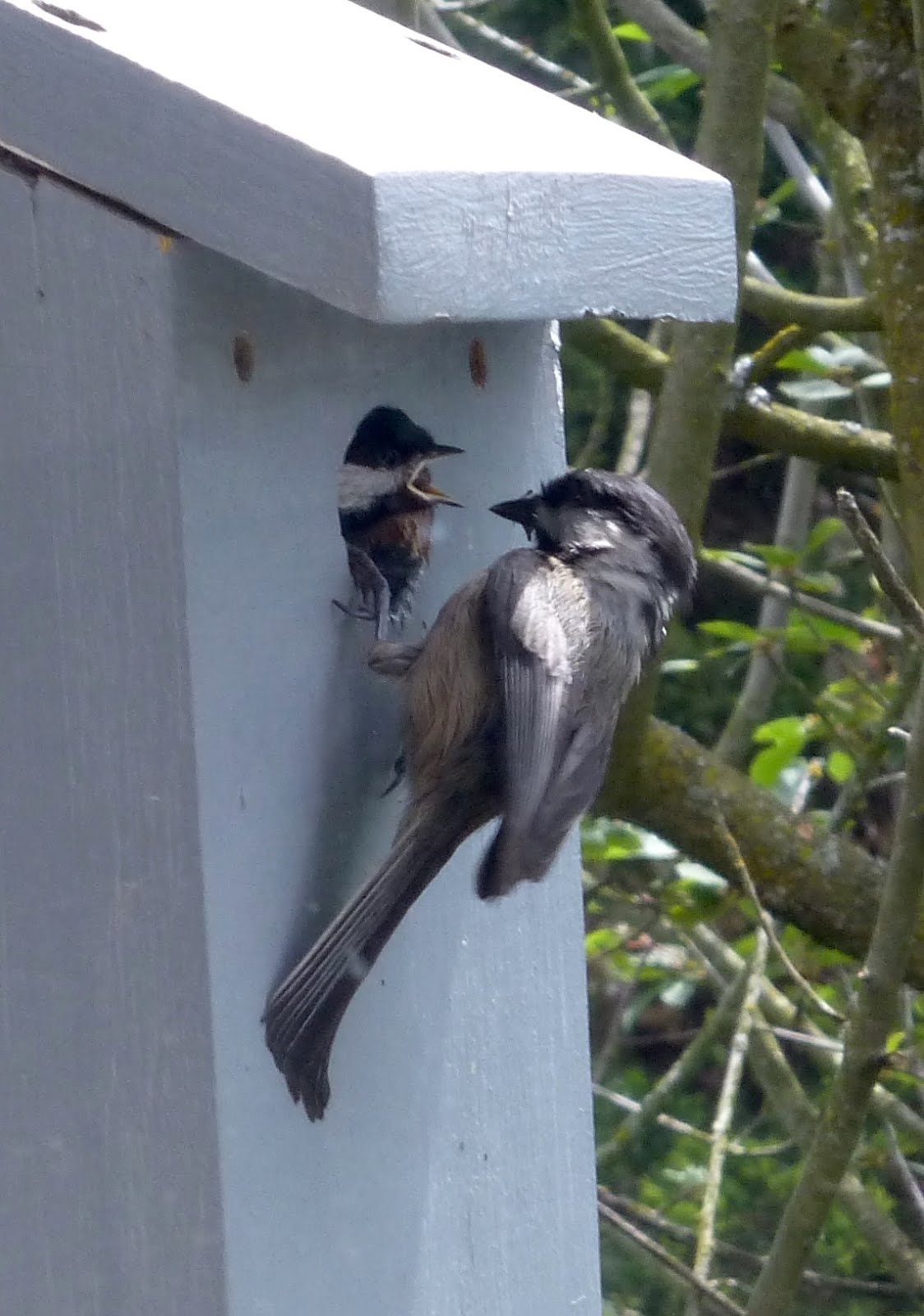
But I hadn't seen any demolition notices and I was a little taken aback when the downy woodpecker showed up and started whacking away at the front door. This is a concern. According to the literature, chickadees are fussy about their door size. One and a quarter inches. One and a quarter inches. This woodpecker was definitely messing with the template.

And I wondered: do downy woodpeckers nest in boxes? If they can get their bodies in? It might seem to normal people that I know a lot about birds, but I don't. I'm always picking it up on the fly, as it were. Turns out woodpeckers are fine with nesting boxes. But of course this isn't the time of year they're likely to be churning out fresh woodpeckers. I read on.

Roosting boxes! I didn't even know that was a thing. This is one of those big important bird things I knew nothing about, but always wondered: what do they do when it's really stormy and windy out? And where do they go at night?

Entry door, post-pecker
It was particularly breezy yesterday and I watched a few birds on the tippy top branches of a tree that was rocking and rolling. It looked like it could be a lot of bouncy fun, really, although I suppose if you can also fly it might not be such a thrill. One thing I do know. They don't have to clench their little feetses to stay on a branch. That would be dreadful, trying to get a decent night's sleep while hanging on for dear life. What we call birds' feet are just their toes. The part that you think is a knee is their ankle. Their knees are right up near the basic bird silhouette where it starts to get personal. If you can see their hips, you've done something rude.

And there's a tendon that runs along their legs that holds their toes in grabby position. That's the default. They have to operate the tendon to open their toes, so basically, they're snap-on, snap-off accoutrements. They're not likely to fall off a branch; they have to motivate to do that. The hummingbird, which spends every night in a stage of near-death, has even been observed to hang upside-down from a branch while sleeping. So you could set it swinging, if you wanted to. You'd kind of want to, but that would be rude also.

Bonus woodpecker
Still, how do they cope with extreme cold and wind and sleet and plagues of frogs? The answer for many is they roost. They get together with their pals and bunch up for warmth in a house or a hole. Some birds roost every night but some just hunker down when it's icky. Our downy woodpecker might be trying to remodel the Windowson place for winter sleepage.

Apparently the chickadees might occasionally use the old homestead for that too. I'd hate to think of what they'd do if they bombed into the place and found it stuffed with woodpeckers. I'm all for letting Nature take its course but if I see Marge and Studley in a little tent by the freeway, I'm going to intervene.

Wednesday, March 28, 2012

Woody

It's spring, and a woodpecker is hammering away on the neighbor's tree, checking for bugs. It's likely either a Downy or a Hairy woodpecker, which differ only slightly, but even novices can readily tell them apart by asking a real birder. Sometimes they hammer on a chimney. There are no bugs in there--they're trying to attract a mate. The flicker that likes to drill holes in our house succeeds, at least, in attracting Dave, and he's not easy. Well, yes, he is easy. Still, woodpeckers are attractive.

The males in particular are often crowned with a bright red patch which they use as a sexual signaling device. They also have short, stiff tails that help anchor the bird to the sides of the tree while he's hammering and support him while he's climbing. Humans lack this and must resort to a crotch harness, which doubles as a sexual signaling device.

Many people wonder how the woodpecker avoids brain damage while he hammers away. Bird experts ("ornithodontists") point out that, for one thing, he has a very small brain. So he's utilizing the same sort of evolutionary stratagem that protects humans from debilitating tail injuries. I'm not sure I buy it. Although it is true that brains and peckers are rarely associated, the real reason woodpeckers don't get headaches is that their children all leave the nest in under a month.

And they don't have a lot of room for brains, because they need to free up the space to store their tongues. Many species of woodpeckers have a long tongue for exploring cavities and retrieving insects and sap. Then they have to reel it back into their heads so as to remain properly aerodynamic. So they run it up the backside of their skulls and tuck it in at the nostrils. Hummingbirds have a similar design. When they make little hummingbird yummy noises you can see the tongues go back and forth over the top of their heads. I'd like to think that the ability to ripple your head when you're happy could be a sexual signaling device, although for hummingbirds, which also have little fingers on their tongues, that might be gilding the lily. I know if a human were to develop little fingers on his tongue, word would get out.

Creationists, or proponents of Intelligent Design, are people who are more comfortable with mystery than knowledge, and they like to point to the woodpecker as being an example of Irreducible Complexity, proof that God had to have stamped it out whole, perhaps from a perceived shortage of time. As evidence, they point out that the woodpecker's tongue is anchored in its nose, which is not true, and that only God would think of doing such a thing, which might be true although we'll never know because he didn't do it, and that (most importantly) it directly contradicts Genesis, which is undoubtedly true, end of story, amen.

In reality, mutations can result in structural changes whose functions change over time, or fall into disuse. In humans, a hallmark of our evolution is our large brain, which allowed us to fashion tools and develop strategies and acquire knowledge so that we were able to achieve considerable success in spite of our physical weaknesses. Now, in many parts of the population that prefer mystery to knowledge, the brain is no longer being used much except as stuffing so our hats don't fall off. Only time will tell if this is a useful adaptation. I plan to keep exercising my own brain, just in case I need it later. Or at least until I can ripple my head.