Showing posts with label murres. Show all posts

Wednesday, October 16, 2019

Wherefore Art Thou Murr?

Murrelet Halterman
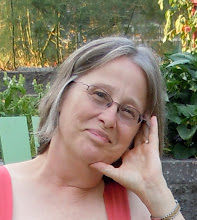
Got a message the other day. "Do you get Birding Magazine? There's a Murrelet in there."

I hadn't gotten the latest issue but I wasn't surprised to learn there was a murrelet in there. That's where I'd expect to find one. As opposed to, say, Sports Illustrated. Not an actual murrelet. They're small enough, but not flat enough. I figured there'd be an article about the Marbled Murrelet.

They're incredible little birds. In a world wherein we might assume we've found out everything by now, the murrelet's life has remained a mystery until very recently. They are sea birds, but they breed onshore. Somewhere. It took a lot of legwork and time, but a dedicated group of scientists finally discovered they nest in the very highest parts of very old and very tall conifers. They find a small cushy platform of moss or lichens swaying way the hell up there and they pop out a single egg on it, sit it for a month, feed the baby fish for another forty days, by flying fifty miles to the ocean and back at least twice a day, and then the baby up and flies to the ocean by herself, if she's so very lucky to still be alive. It's a tough road. And if there weren't a hundred other reasons to leave those Pacific old-growth forests the hell alone, that would be enough, right there: murrelet eggs, on a high moss cushion.

Yeah. I read a whole book about them. But that wasn't what was in the Birding Magazine. Instead there was an interview with a surpassingly cool woman named Murrelet. Murrelet Halterman picked her name out herself.  She's another Mary slid sideways. She was flipping through the bird book and picked that one out for a nickname, figuring "it was enough like Mary that her parents wouldn't notice." A different woman might have gone for Robin or Lark, but clearly Murrelet has a certain kind of class. Also, she is a nutcase. I like that in a person.

My own Mary name slid sideways without my intervention. It's easier to report that my college friends were too stoned to pronounce Mary, but it's not really true. What happened was my friend Walter and I were pretty much the only Southerners in the whole college, which was populated almost entirely from New York, New Jersey, and New England. Walter was from Atlanta. This was the closest either of us was ever going to get to feeling ethnic. We started drawling in each other's company just for drill and solidarity, and it proved contagious. Pretty soon everybody was saying things like "Turrible, turrible." (We opted for Walter's more adorable accent. Nobody wants to hear the version from Virginia, where my name would be pronounced "May-Ree.") Thus and then I became "Murry." And eventually "Murr," because my friends were too stoned to...well. Anyway.

I was certainly not going to spell it Myrrh. Too fancy. And I had no idea that there was such a bird as a Murre. I wasn't a birder. Forty years later, when I joined that fraternity as its least adept member, it was too late. Theoretically, since Mom didn't name me Murr, I could add an "e" whenever I wanted to, and some of my friends do out of affection. But by now it feels like putting on airs.

In any case, Murrelet and I aren't all alone in this. My Dave married a girl just like the girl who married dear old Dad: Mary Alice Price.

Her friends called her "Murry."

Wednesday, August 27, 2014

The Wraith


When I have visitors, I like to take them on mountain hikes because that's my favorite thing to do, and so I'm pretty sure it's their favorite thing too, even if they don't realize it at first. These are five-star humdinger hikes, with meadows and hummingbirds and paisley drifts of wildflowers in every color and vistas of volcanoes on the horizon and a scatter of beeping pikas and, theoretically, maybe even a fat furry marmot: every component, in other words, of true happiness. And the hikes are mostly flat, too, except for being inclined at a sharp angle. Remarkably, several decades'-worth of visitors have--independently of each other--referred to my hikes as "death marches." I'm sure it's meant affectionately.

When Linda and Walter came for a vacation actually devoted to hiking, I made sure to front-load the event with my very favorites, figuring they would be left breathless by, probably, the beauty. And then we went to hike on the coast, where a surprising portion of the beauty is at sea level.

Everyone loves the ocean. People in the personal ads always say they like long walks along the beach. No one ever mentions death marches. Walter and Linda were thrilled. The waves roll in and out and people stand before them mesmerized, as though they are watching infinity in a frame, and are somehow comforted by that.

I'm not. It creeps me out. The ocean is just fine from a distance, like a hundred miles, but up close it's all drowny. There's nothing but water out there and most of it is over my head. There's teeth and tentacles and stingers and slithering and darkness and death. It reminds me of the very dwindlety of life, crushed under time, the waves inexorable, doom, doom, doom, and some day one of them is going to take me out. Somewhere out there is my wave, getting a suggestion from the moon and a spin from the rearing continental shelf and beginning to crank my way. I can't look.

But there are distractions. The cliffs are a frozen snapshot of lava hitting the sea. Birds coat the sea stacks. Every tidal puddle is its own neighborhood. We tread the sand for hours and nobody gets even close to dead. I begin to relax.

"What's that?" Walter asks, pointing at the shoreline.

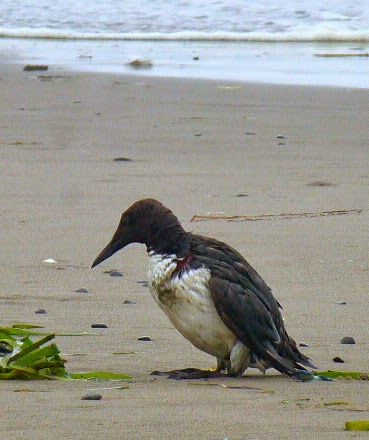
I raise my binoculars. It's a murre, and it's all wrong. Murres shouldn't be standing at the shoreline all by themselves. Murres should be diving for fishes and flying in bunches and jamming the tops of sea stacks and pooping on rocks. Murres definitely shouldn't be shuffling their feet and letting me walk up close enough to take a picture.

My murre is dragging a wing and has a major gash on her breast. My murre is going to die soon. I long to wrap her up in a fleece and drive her all the way back to the mountain and leave her in the custody of a kindly marmot with a well-stocked larder and a dab of mercurochrome. But I turn to leave. I got the message, friend murre. It's all teeth and tentacles and darkness and doom out there.

Wednesday, May 23, 2012

The Murre, The Merrier

Sarah. Looks mean, right?
Sarah Swanson is a very nice person who thinks my blog is hilarious. But I repeat myself.

She wrote me a letter asking if I'd like to join her Audubon Birdathon group. It's a fundraiser. People can sponsor you with a flat donation or give you a dime or so for every bird you turn up. She hoped she wasn't being presumptuous. What Sarah didn't understand is that if you tell me you think my blog is hilarious, I will bake you brownies. I will pick up trash on your section of highway. I will paint your house. Of course I agreed to go along. "But I might not be very helpful," I pointed out. "I love birds, but I'm not good at identifying them." My brain is like a colander. It's well-ventilated, but real knowledge runs right through it, leaving behind the noodles of unrelated factoids.

Sarah didn't mind. Her fearless group is named "The Murre The Merrier," and I could be their mascot if nothing else.

Still, I thought this time I might come in handy. I'd just come off of a week of birding in West Virginia, home to 14,000 species of migrating warblers, and I got to where I could pick out those little treetop nuggets like nobody's business. Sadly, in Oregon we only have two warblers, Steve and Larry, and Larry is peevish and shy.

Even the white-crowned sparrow counted.
Sarah gathered her platoon of bird warriors and gave us the battle plan. We were aiming for 100 species. She and her husband Max Smith had scouted the territory for key locations, and she intended to keep us on the march to cover them all. There would be no dawdling on this team. This was not a walk in the park: this was full contact birding. Sarah slipped a sharp stick into her pocket and off we went.

Our little score card lists 376 bird species we might encounter in Oregon. Of these, a hundred are bashful, a hundred more are just passing through, and some, like the Flammulated Owl, are entirely made up. We began on the grounds of the Hillsboro Library. In under an hour we had bagged 30 species, including a confabulation of acorn woodpeckers and a great horned owl. Excellent, I thought. In another two hours or so we'll have this baby wrapped up. We moved on to a wetland. "We're looking for bittern, marsh wren, Virginia rail, people. Go, go, go!" We went, went, went. We scored, scored, scored. Sarah mashed us all back in the van and we hurtled off for the coast. Birding is always an adventure, not least because birders drive with their heads out the window and cranked up toward the sky, and they brake for no apparent reason.

The magnificent Max Smith, co-leader
Haystack Rock is an iconic geological wonder in Cannon Beach formed from millions of years of accumulated bird poop. We met up with our totem birds, the short, stout, plain little items inexplicably named Murres. Pigeon guillemots. Brandt's cormorants, their turquoise throats flapping in the sun. Sarah retrieved a cattle prod from the glove box and away we went again.

It was a sharp group. I was completely outclassed. Halfway through the day my strategy was to look for very recognizable birds we hadn't seen yet, but when someone else spotted the Great Blue Heron (#64), I had nothing left in my quiver, and was reduced to wasting everyone's time by pointing out suggestive sticks in the water and little lichen-covered bumps in the trees.

We racked up shorebirds by the plattersful, whimbrels rocking up and down like sewing machines, red-necked phalaropes spinning in circles like gears, and turned back inland, inching towards the 100th bird, the trumpeter swan. We reached a consensus on the trumpeter, after failing to find the tiny yellow spot that would mark it as a tundra swan (although, according to the field guide, some of the tundra swans also lack the yellow spot, and yes, this is deeply unfair). And then we scored a back-up snipe. Which we needed when the trumpeter swan was revealed to be somebody's pet. Sadly, birders are much burdened by ethics.

And then off we raced to a couple more spots in the woods before collapsing exhausted, twelve hours in, with a total of 105 species. Sarah stood proud against the sky, triumphant and satisfied, resplendent in fishnets and leather and stroking a small whip. Let it never be said birding is a sissified venture.

I, for one, am completely flammulated.

Wednesday, July 6, 2011

A Family Reunion

I came upon a glory the other day, a sight to behold--made me all trembly. And it's a good thing Dave wasn't there for it, or he might have keeled over dead, and not in a good way. I saw five billion murres in one place. He's in favor of murres but thinks they are best in small and manageable numbers, such as One.

My murres were massed on several rocky outposts in the Pacific Ocean, jammed in together, which is what they do when they're brooding. I have many similarities with my cliff-roosting cousins, but there are divergences. For instance, no one wants to be around me when I'm brooding.

Also, murres are good at flying, whereas I'm only good in the gravity-assisted direction and for a very short time. They are also good swimmers, and I am not. No one taught me when I was very young, which is the time to do it. Dave learned at an early age, himself. He says it was easy. The hardest part was getting out of the burlap sack. Murres learn very young. They are punted or fall off the cliff and we don't hear from the bad swimmers again. They are excellent divers; they can be underwater for a couple minutes, where they are said to be very maneuverable. I am also. Once I quit struggling, I expect you could tow me just about anywhere.

Murres gather on cliff tops to breed and lay eggs. The eggs are very pointy so that they will spin in place like a dreidel instead of rolling off the cliffs. And this is important because the murres do not bother with nests. According to the biologists responsible for murre egg monitoring, the female murre turns around and takes a good look at her egg when she lays it, so that she can recognize it among the other thousands of eggs on the cliff later. Supposedly each egg has a slightly different pattern and is thus recognizable, but really they all look the same--they look like shit-spattered rock, which is surprisingly handy for camouflage. One egg is pretty much like another, and that too is apt, because one murre is pretty much like another. I'm not sure it matters much who's incubating what. Any way you look at it, you're getting a murre out of it, and you shouldn't be looking for anything else. This keeps them emotionally stable too, when bald eagles come flying patriotically in to eat an egg. All the murres flap and holler for a while but after a certain point they all go away and hope for the best, and the eagle makes her selection, and Gladys and Ethel can duke it out later for the remaining egg. "That's my egg," Gladys says, and Ethel says "suit yourself," and goes off somewhere to get a little reading done. Once all the kids have fallen off the cliff, the girls molt and stick around for an extra month, maybe form a book club, and they don't rejoin their mates and young out at sea until their 'do grows out.

Just between you and me, a lot of field biologists haven't dated in a while, and are inclined to idolize their mothers. It's possible murres are carefully memorizing their own eggs, but I submit that any time something drops out of your butt, you're liable to turn around and have a look. I've given this whole issue a good half-hour of binocular time, and these ridges are coated--coated, I say--with identical birds. I believe if any one of them sees an unsat egg, he or she is going to sit on it. If it cheers up a biologist to believe that it's their very own, so be it. This looks less like a paragon of motherhood than a cocktail party with unsupervised children up past their bedtime. They find a big rocky promontory, they shit all over it, drop eggs on it, and then punt the little buggers over the edge when they achieve fluff. Then they get a new haircut and lounge around for a month and no one even talks about the kids.

Murres are also known for preening each other, although it is unclear if they know they are doing this, or think they're taking care of their own hygiene and can't tell each other apart. Both sexes are identical. The description in the field guide is "black head with white underpants," or "underparts," depending on your trifocals.  Scientists insist that when they fly to their roosts on the rocky cliffs, they unerringly find their own eggs, and it is true that landing is a chaotic affair; they sort of fold up and drop in wherever they want to, without bothering to see if someone else is already at that spot. There's a lot of flapping and shoving and eventually everyone settles down until someone else bombs in. This is the evolutionary reason they have developed webbed feet: to avoid head punctures.

Murres are large members of the Auk family, named after their entire vocabulary. There was a larger one, but it is extinct, and the wise murre reins in her aspirations.

This particular platoon of murres is lucky enough to have its rock right in the sea, so that the punted chicks, which cannot fly, have a high likelihood of making it to the water. Other colonies nest on cliffs just inland and the chicks have to bump along a bouldery beach for quite a distance before reaching the sea and a ticket to adulthood, a path strewn with predators and tragedy. This is an evolutionary method that goes at least as far back as the 1950s, when our parents sent us out to play in traffic, assuring that children who do reach maturity are those genetically blessed with insane luck.

Wednesday, March 9, 2011

Murr: It's What's For Dinner

I am proud to know someone from Newfoundland, a region whose existence has only been verified in my lifetime. My friend Sara is a repository of disturbing facts, among which is the revelation that people in her part of the planet eat Murrs. Or not murrs, precisely, but murres, the dashing and athletic sea bird with the dapper black-and-white outfit, shapely rear end and world-class sense of humor. Only they do not call them murres, but "turrs." It would seem odd to mispronounce a word like "murre" in this way unless you take into account that in Newfoundland, above-freezing is not their native temperature, and initial consonants can be unpredictable.

Besides, my own name only came about because the people I went to college with couldn't pronounce "Mary," so we've got no room to complain. Its spelling is thus arbitrary, and has been reinterpreted variously as Myrrh, Muir, Murre, Merv, Merle, and Sally. Nevertheless, it's mine now, and I'm not sure how I feel about being fried up with carrots and potatoes.

I do know that I'm not likely to partake of one myself. That's not out of any allegiance to murres, but because Sara says they're greasy and stringy. There is a bit of a taboo about eating your own kind, though, most places. It's frowned upon in America, for instance, which is a quite typical attitude in countries marked by obesity. The subject probably never comes up in your more gristly populations. But survey a random sampling of Americans and you're likely to find they think human meat tastes immoral.

Actually, the flavor is probably not the problem. Human meat is called "long pig" and is reputed to be delightful. There are contradictory texts, however. In the Bible, it is reported that during the famine in Samaria, two women agreed to boil and eat their sons, and the first woman did so, and shared the meat. But the next day the other woman did not pony up; so maybe it was not so palatable after all.

No one really knows how prevalent the long-pig cuisine is, world-wide. There is evidence of it in Neanderthal populations, where a good eyebrow roast could go a long way. In my youth it was depicted fairly often; the typical scene in 1955 A.D. (30 B.P.C.) shows a duo of white men, one of whom is usually Bob Hope, in a large stewpot attended by dark chefs whose accoutrements are made of disassembled skeletons. Nowadays it is rare to medium-rare to see such a depiction.

Some cannibalism was observed during the days of Christopher Columbus, and when Queen Isabella decreed that Spanish colonists were only allowed to enslave natives who were cannibals, their numbers spiked dramatically.

I'm probably not as averse to the practice as most people; at least I'm not willing to reject it out of hand. "How can you even think about eating a human being?" I've been asked, and I'm not entirely sure how to answer that, but I do know butter and salt would have to be involved. For all I know, I've already had some. When someone does all the cooking for you, you don't ask a lot of questions. The main reason I'm against it in general is out of self-preservation. I'd be the first to go. Some of my flesh is already falling off the bones. When people seem to be giving me their full attention as I rattle on about this or that, they might well be thinking: "mmm. Juicy. Good cracklins'."