
Showing posts with label flatfish. Show all posts

Saturday, August 3, 2013

The Mirror Test


I brought up the Left-Gaze Bias in the last post. Evidently, we humans look at each other most avidly on the left side as we're facing each other (the gazee's right side). That's where we have learned to read each other's emotions, because that's where they leak out, propelled by our emotional left brains. But this bias also has implications when it comes to looking in the mirror. When we look at ourselves in the mirror, we look at the left side the most. It's just force of habit. Ideally, you should be well enough attuned to your own emotions that you don't need to check out your right eyeball to find out what they are. But the problem is that the mirror has the sides flipped, so we're no longer looking at the tell-tale side, the side that everyone else looks at. That means we tend not to like photographs of ourselves, because they're all backwards and the eye we're used to looking at is on the wrong side. When I see a photo of myself, I instantly notice the gigantic mole on my right eyebrow, which looks unusually prominent because I'm usually looking at the other side in the mirror. This means when other people look at my face, they're looking at my mole. And they can read my emotions. My primary emotion is "shit. You're looking at my mole."
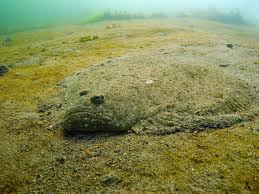
This is not a problem with all animals. Flatfish start out looking like regular fish with an eye on either side of their skinny vertical bodies and then one of their eyes begins to migrate over the top of their head and joins up with the other one, and they flop over ninety degrees and drift to the bottom of the sea and gaze up with both eyes now on the top side. When all is said and done, it doesn't look right. It's never even. If young flatfish ever do try to look at each other's right side, next time they meet they might find the entire side has shlorped over to the left side. This would be fatally disconcerting, in a social sense, and so it is assumed that flatfish are not well developed emotionally.

In some social situations, this mirror business causes problems. Many times when people take photos of themselves to use in, say, social networking sites, they snap a photo in the mirror. This is one of the
reasons people complain that the person they met on line does not look at all like his picture. When Heather goes to meet that cute boy Jason she met on line and is disappointed in him in person, it might be because Jason had taken a picture of himself in the mirror. Also he's forty-seven years old with soiled pants.

Mirrors have been used by scientists to gauge self-awareness among many species, including humans. In the typical mirror test, a bit of schmutz is dabbed on the animal in a spot it could see only by looking in the mirror. If he reaches out to the schmutz on himself, he is said to pass the mirror test. That is, he recognizes that the image in the mirror is him. The human child undergoes a predictable pattern of responses to a mirror. At up to a year, the child sees the reflection as another possible playmate. Self-admiring begins at one year, followed by avoidance behaviors, which go away and do not resurface until menopause.

Not too many other animals pass the mirror test, but among them are all the great apes. Lesser primates have been shown to be significantly less narcissistic. Pigs can use a mirror to find food, but because they really do not give a rat's ass how they look or how much schmutz they have on them, human scientists have assumed a lack of self-recognition. Cows are not expected to develop self-recognition until they evolve fingers. Results with rutting elk and mirrors are inconclusive, but seem likely to result in seven years of bad luck.

This field of mirror research is still new, and the science about Donald Trump is unsettled. He is said to do his own hair, which leads some researchers to conclude he has a mirror, and others to conclude he couldn't possibly.

Saturday, March 17, 2012

God Should Have Quit On The Fifth Day

Science has been unable to pinpoint which day of the week God created man, but for sure it was after he created salamanders, which showed up mid-afternoon of the fifth day. That was a barn-burner of a day for God, and he was justifiably proud, and probably went a little manic there for a while until he got some mud and made a man out of it, and after that he had to rest up. The book says "rest up," but really, he probably realized he needed to put the brakes on and think about what he'd done, because he'd totally overshot. It happens. Creative types frequently come up with their masterpiece early on and then spend the rest of their lives trying to replicate their success, and it never works.

"Day" is probably not meant to be taken literally, because God is more poetic than that, and bigger in general, with much longer days and a much greater imagination than us little mud-cakes he slapped out on the sixth day. So the salamander sort of worked things out on his own, with one great idea after another. There he was in the ocean, where things are constantly trying to make a snack out of him, and so he got closer and closer to shore, rolling his eyes around in alarm, until at one point there they were--his eyes--right on top of his head. Whoa! Genius. He could stay underwater where the oxygen was, and still see everything above the water. Like the land. Which, as far as he could see, contained nothing that wanted to snack on him. At that point there wasn't much more to do but fiddle with the flippers and do some push-ups and before you knew it, the first salamander hitched up on shore, where he grew the biggest and nicest smile anyone ever had before or since, and why not? He'd gotten everything just right. Lo, he was very good. And so he took the entire kit, handsome smile and all, right through to modern times, with barely an adjustment.

It might seem far-fetched about the eyes rolling around on the face, but it happens. Even today, flatfishes start out swimming sideways like regular fish with eyes on either side, and then one of their eyes migrates around to join the one on the other side, and then they drift to the bottom of the sea and blend in, with their eyes on top checking things out. It isn't the Mozart Requiem but it's still pretty cool. The eyes never look quite even, but it's the best they can do, having traveled around the side of the fish. And so you see this sort of thing in Nature all the time: halibut. Flounder. Shannen Doherty.

When God came up with the man, he told him to have dominion over every living thing, which was a big mistake, if you'll pardon my saying so. Sure, you're tired, you've worked hard, and it's tempting to just tell the kids to take care of everything, but that's how you get mud tracked in the house and candy for dinner and the credit card gets run up and all the forests turn to desert and someone cranks the heat up to high so they can sit around in their underwear all winter. It's not responsible. It's not all bad, but you're going to run through a hundred years of oligarchs and Republicans for every Mozart that shows up.

I have the good fortune to know people who do know their proper place in the world, and that place is chest-deep in a cold bog in February. Yes, the regional government Metro has sent out its intrepid Frog Warriors again this year to get a rough count of amphibian egg masses, so we can see if we've done a good job restoring wetlands to what God had in mind in the first place. It's an honor and a privilege to bear witness to the single greatest feat any critter has ever accomplished, something humans couldn't do in their wildest dreams: making new salamanders. No wonder they're still smiling.