Showing posts with label birding. Show all posts

Saturday, May 19, 2018

Notes From A Lesser Birder

The Murre The Merrier: photo by Diana Byrne
Somebody has to be the worst birder in the Birdathon van, and I for one am not afraid to step up.

I had hope that things would be a little different this time. I've made strides. I pick up a little more knowledge every season. A few years ago, I was astonished when our fearless leader, Sarah, pointed up to some frantic dots halfway to the moon and said "Vaux's swifts." Whuh? How? And yet now I not only recognize them by sight, but also by voice. (They sound like photons swapping secrets.) I was ready for Vaux's swift.

And three years ago I thought she was making things up when she pointed out the Lesser Goldfinch, which, as it turns out, is totally a thing, and not a value judgment. In fact I now know it as one of the commonest birds in my yard, and I know its song, too. I was super ready for Lesser Goldfinch.

And, most significantly, I recently shaved a whole thirty seconds off my personal-best identification time for the female red-winged blackbird, a.k.a. that brown bird that's the only other thing in a marsh full of real red-winged blackbirds. The first time I saw it, I paged through the entire field guide looking for it, finally determining that it was a previously undiscovered species, which should excite other birders, but it doesn't. Anyway, I snapped off that ID in under a minute this time. I know--I'm amazed, too.

So off we went, and while the team was slurping coffee and easing into the day, I shot my arm out and bellowed AMERICAN CROW. Yeah, baby, in the bag! Mark it down and ink my initials next to it. I'm going to take a nap now.

But I longed for more glory. At our first stop I bounded out and squinted into the fog, but one by one, my aces in the hole showed up in someone else's hole, no offense. Anna's hummingbird, bushtit, black-capped chickadee, even Wilson's warbler, which I considered to be advanced--all of them quickly fell by the wayside. By the time I've got a bird in my binocs and a good read on it and am just about willing to go out on a limb with it, someone else has nabbed it right off its limb. Discouraged, I mentally reviewed easy and gigantic birds yet to be found, to no avail. Turkey vulture, red-tailed hawk, great blue heron, bald eagle, all of them landed in someone else's eyeballs before they landed in mine.

Pigeon Guillemot. Sure.
Meanwhile our other fearless leader Max glances at a featureless horizon and says "pigeon guillemot" and, when I look distressed, kindly says "Here, I've got it in the scope for you," but I still can't make it out. The only thing holding Max back from identifying all the birds is the curvature of the earth.

I've come to understand that we're not all possessed of the same talent. Sarah and Max and everyone else in the van have been able to sweep arcane details about birds into their brain pans and fry them up until they're crisp and accessible. Most of my bird details get accidentally tossed off the cutting board and down the garbage disposal before I get the burner on. We can't all have the same skills, and I'm freakin' deadly at Bananagrams.

But there was glory yet in store for me. Per my usual method--see where everyone else is looking, and look somewhere else--I spotted something interesting and hopped up and down squeaking ("See something, say something") until someone lumbered over with a spotting scope, found it in the sights, and identified it as a black-bellied plover, which I'd never heard of, in spite of which I went ahead and took credit for it. Loudly. That was my black-bellied plover, on account of how loud I was about it, and consequently they gave it to me and they can't take it away from me. Boo-yah.

We never did see a lesser goldfinch.

Wednesday, March 7, 2018

The Junco Drawer

When you do start noticing birds, you find yourself becoming familiar with their habits. You might notice that the juncos, for instance, park their fannies on the feeder and hoover sunflower seeds. If the seeds still have hulls, those go flying off like Frisbees and the meat goes down the hatch and it's on to the next seed. That's not a big feat--I've seen Norwegians do the same thing. But a chickadee pops up and takes one single sunflower meat out and runs to the nearest branch with it. It then pins the meat down with one adorable little toe and shaves it down until it's gone, and then it thinks about maybe going in for another. They're very dainty. The chickadee is eating grapefruit sections with a serrated spoon, pinkie extended, and the junco is on the beanbag chair dumping a bag of chips in his face.

I'm assuming the chickadee is a pluck-and-go guy because he's cautious. This doesn't seem to be a factor with the juncos, who actually spend less time at the feeder proper than they do on the ground underneath. That's where they spend most of their time, which is a pity, because so does my neighbor's cat, Sid. Juncos don't care. They look around and all they see is other juncos all over the place and they figure odds are it's some other guy who's going to get whacked.

I have gobs of juncos and they don't look alike. They have white outer tail feathers and they flick them when they fly, and that's about all they have in common. We have dark-headed ones and gray-headed ones and ones with brown sides and ones that are only gray and white, and every last one of them  is called a Dark-Eyed Junco. When I visited my sister in Colorado, I saw some real cool-looking bluish birds with rusty backs. I'd never seen them before, but they acted like juncos. And guess what they turned out to be? Juncos. Dark-Eyed Juncos, just like mine.

It's a little disheartening when you're already a sort of shitty birder and you've spent all that time peering through your binoculars and totting up all the ways your birds are not at all like each other, only to be told they're one and the same. You've got one wearing a gray vest and a dark topcoat, and one with an executioner's hood, and one is mostly gray, and one might even have a corporal's stripes on his wings, but you do not have four different birds there. You get to add only one of them to your Life List. You can score a different junco if it turns out to be a Yellow-Eyed Junco, but he's about to be on the other side of Trump's wall.

Meanwhile, we have three different brands of chickadee here, the Black-Capped being the most common, and they look different from each other, but no more so than the Dark-Eyed Juncos do. However, elsewhere in the country, you might find yourself in territory shared by the Black-Capped and the Carolina Chickadees. Good luck telling those bastards apart. Evidently there's a line north of which you have your black-capped and south of which you have your Carolina, but unless one of them has a drawl, there ain't no difference between them. One is the eensiest bit greener on the back, until the light changes, and the other is slightly less fluffy, unless it's cold. I recently gazed at painted renditions of the two and I couldn't tell them apart even with the captions and arrows pointing out the differences. You want to add a Carolina chickadee to your life list, you can probably put a black-capped in a shoebox and drive south with it.

The good news is Sid the cat got run over by a car. My neighbor has his ashes and I invited her to sprinkle some under our bird feeder, since that was his favorite place to hang out. She said she would. Maybe if all those different juncos figure out who to bang this spring, they can use the calcium for their egg shells.

Wednesday, May 25, 2016

The Dufus Invasion

We're not either of us real good birders, but we do pay attention, and that's the first three steps in the birding manual. So we stopped dead in our alley the afternoon we heard a new voice. Who. Who-whoo. Who.

"Is that an owl?" Dave was incredulous. It wasn't out of the question. We'd seen a barred owl slumming right here in the city that summer.

"What kind of owl hoots in the middle of the day?"

Well, I'm not sure, but maybe a dumb one. And owls in general aren't known for their intellect, no matter what you've heard. They've got the big fancy eyes and a real tiny head, and something had to give, evolutionarily. And that was the brain. It's probably the size of a pistachio. Still, they're smart at being owls. So they really should be snoozing in the afternoon, to gear up for a nice midnight rodentfest.

We stared into the likely owl crannies of our tall trees and came up short, even Dave.

"Sounds kind of like a dove, actually," he said. It did. Not a very interesting dove, either. Who. Who-whoo. Who. Over and over. For the rest of the day. It was starting to get annoying. It was as if the local nuisance dog had had the bark spanked out of him and substituted a nose whistle.

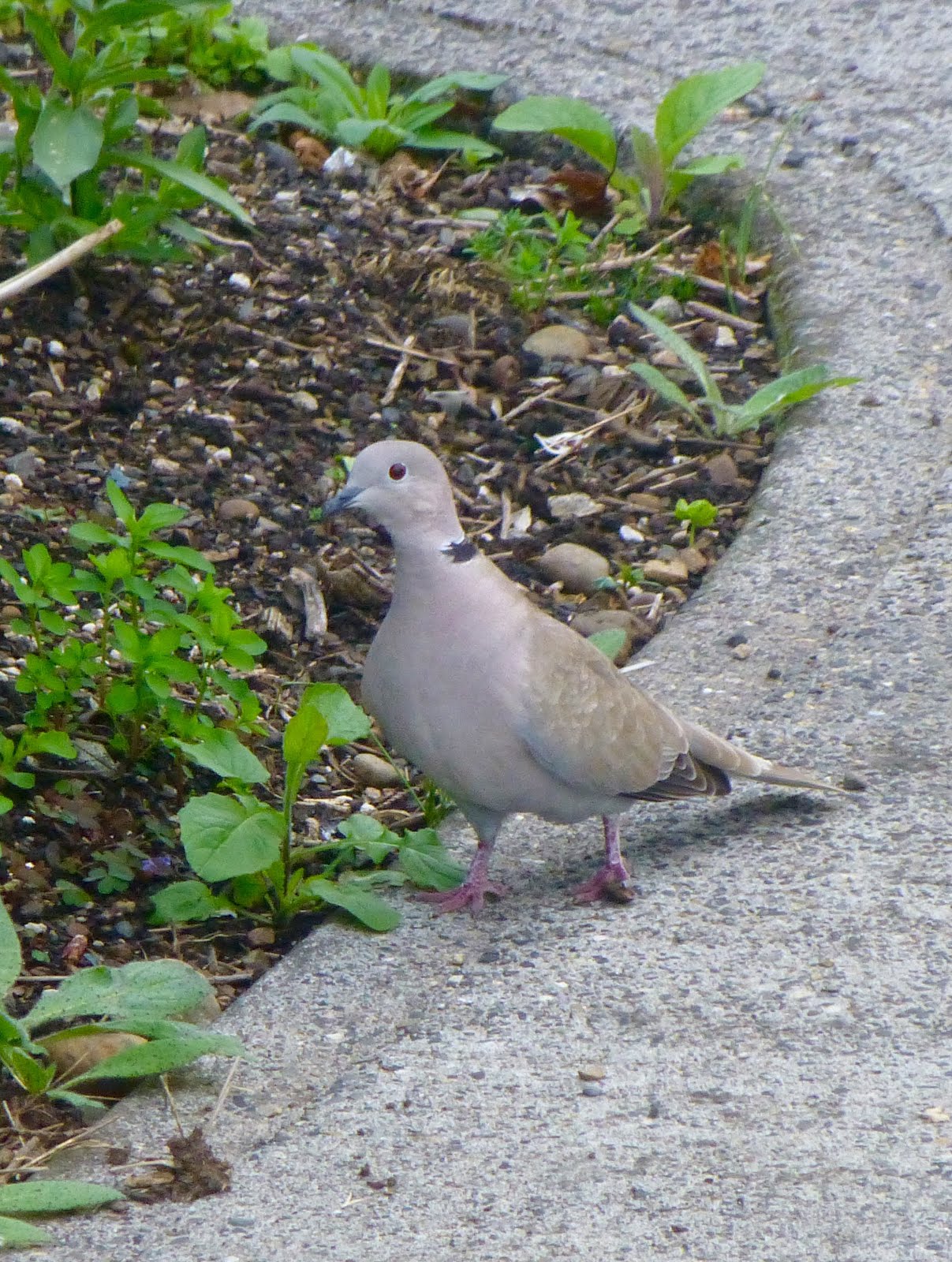
And that is how we were able to pinpoint the actual day the Eurasian Collared Doves moved into our yard. I'd heard of them. And what I'd heard is they're taking over.  They'd gotten a purchase in the Southeast and fanned out from there. They breed all year long. They're Catholic; that's why the pope dropped some on Vatican Square, where they instantly got snapped up by a heathen hawk.

I'm not really a dove fan. They're just pigeons in a different suit, and I'm not a pigeon fan. We're talking about a bird so dim its head has to keep catching up with its own feet when it walks.  Maybe it started when I was a kid. I knew the song about the two turtledoves, which, in my imagination, came complete with carapaces and plastrons and balanced delicately in the branches. So to find out they were more dove than turtle was a disappointment.

"Dove"comes from the middle-English "dufa," from whence we also got "dufus." And the Eurasian collared dove in particular comes from the old world, via the Bahamas. A bunch of them got released during a pet shop burglary, probably engineered by the doves themselves in a rare spasm of ingenuity. From that point they hied straight to Florida and began dropping anchor eggs all over the continent.

It's bad, people. It's all well and good to feel sorry for a few birds fleeing harsh conditions and incarceration in the Bahamas, but there's no reason to stick out the welcome mat for the whole damn species. Even if only a minority of them is clever enough to have a criminal bent, they're going to drive down wages for resident mourning doves. Nothing good can come of this. We've seen it right here: July 22nd, 2015, we saw our first Eurasian collared dove in the yard, or rather two, because they always have an accomplice. And then, by December, we had a whole cell of them, flappiting around the yard and whooing incessantly.

They've got nothing to say that didn't get said in the first five seconds. And their main food is grain. We need to register them in a database to track them before it's too late. They're a direct threat to the beer industry.

Wednesday, May 21, 2014

West Virginia: Almost Heaven


I'm fresh off my third stab at the New River Birding And Nature Festival in West by-God Virginia, and have once again demonstrated a nearly virtuosic inability to recognize any birds. Seriously, no one holds a candle to me on this. I have the Black And White Warbler down solid. He sounds like a squeaky hamster wheel and nobody else does, and he looks like a little fuzzy zebra and nobody else does. He's mine, dammit. I'm pretty good at the loud, low, whackety one ("ovenbird"), too, and by the end of the week could even name several of the men attending the festival ("Dave").

If you were to look at my brain--it's very thin up there, you can see straight through in a strong light--you would notice that my cerebral cortex is very smooth. Everything slips right off of it, and new information can't get a purchase. At this festival, fortunately, with regard to the bird situation, I am surrounded by freakishly competent, helpful, and in some cases really cute birding guides. They're nice as pie. They're still nice by late afternoon when I tug at their arms at a particularly lovely snippet of birdsong and say what was THAT? and they say, kindly, through clenched teeth, "it's still a Carolina wren."

The warblers are talented. They're like little orchestra conductors. One note and they've got everyone pointing in the same direction. Another trill and binoculars everywhere snap into place. A twist of a little feathered head in the sunshine, and camera shutters are going off in unison.

There are more birds here, even now, than you can shake a stick at, and we know that because we've been shaking one stick or another at them for a while. Their once-unbroken forest home has been well and duly shattered. Their insect dinners are beginning to show up all out of synch with their migrations.  You know you're in West Virginia when everyone is polite and calls you ma'am, and when delight has an echo of doom. And you hear things like:

Look! It's the Least-Spotted Seldom Bird! The last of  his kind! See the tree with the baby car seat and all those tires at its base? He's in the little tree right behind it, just next to that mattress,  up at two o'clock about a foot above the plastic bag.


Click to embiggen, if you dare.
We're at the base of a shimmering green mountain, on the sandy banks of the Gauley River. A Swainson's warbler is hiding in the rhododendrons and being a total tease. Pipevine swallowtail butterflies cling to the wet sand and fan their wings. A foot away is a regiment of plastic bottles, at ease, staged for the next campaign: the Gauley to the New River, lined with coal trains; the New to the Kanawha, the Kanawha to the Ohio to the Mississippi and, yes ma'am, the Gulf of Mexico! Lawsy! Sadly, they will not be able to join their plastic brethren in the Pacific Gyre, where they could have hoped to be picked up, stashed in a crop, and fed to a baby albatross. But they still have the compensation of eternal life.

It's hard for me to imagine tossing aside a plastic bottle, let alone several a day or a pickup-load, but in a world of poverty and Walmart and plastic crap and TV noise, the connection to nature gets snapped off, and is replaced by boredom, anxiety, and the suspicion something has been stolen from us: all of it feels like the dull ache from a phantom limb. You can come to West Virginia and still see everything we are losing, and how we are losing it.

Speaking of conservation, it's not too late to sponsor me in the Birdathon! Your tax-deductible donations support the work of the Portland Audubon Society, and make me dang proud to know you, too. Click here, and thank you!