Showing posts with label adolescence. Show all posts

Wednesday, October 25, 2017

Me Too


Me too, naturally.

I'll start with just a couple, for now. The earliest ones. Nothing too dreadful, or too early--I was raised in a family of decent people and well shielded.  I knew not to take candy from strangers, but what designs those strangers might have had on me were a mystery. Art Linkletter was on the tube, not Girls Gone Wild.

No, my introduction to the peril of being female began only when I'd just started to develop. Eleven, maybe, or twelve. It's not a good time of life. It's the beginning of the end of innocence, and by that I mean the condition of being whole in oneself, the pilot of one's own consciousness, the skinner of knees and the collector of caterpillars. If you're as lucky as I am, you get to be that child for a good while, rowing your own boat in a protective flotilla, allowed to drift at will with a cargo of your own imagination.

Then things start to change, and it becomes ever clearer that navigating the world and its demands and betrayals is going to require some compromise of the spirit, some deceit and pretense. And that's just to keep your head above water among your peers. But there's a wider world.

The first time, I was walking down the block to Robertson's Five and Dime, as I had done for years, every time I found a few pennies in the sofa cushions. I was nearly there when a man, a grown man, pointed at me and grinned. "Hey, I know you," he said.

I probably looked perplexed, and I probably smiled back. As one does.

"You work at the bar, right? That's it! I've seen you dancing at the bar. Oh, yesss." He was really grinning now.

I can't remember what used to be on that corner next to the dime store, but now it was a topless joint. That was a new thing then, and a scandal in the neighborhood. The man grinned harder and his eyes traveled down my body. My new body. I smiled again, probably, and told him I didn't work at the bar.

"You sure look like her though. You could."

I ducked into the dime store, bought a Maryjane, and peered through the window to make sure the man was gone before I walked home. Not that he wasn't friendly. He was real friendly.

It's a mild enough story, but as poor as my memory is, it stands out. What's interesting about it is not the man's ploy, his game, his easy, casual assertion of his own power. There's nothing special about that. "When you're famous, they'll let you," a powerful man says, but even those with nothing going for them will play up any edge they can conceive of, and that edge is often over women. All women, any woman. We're all in the same lower caste and they'll make sure we don't forget it. There's nothing more mundane than that story. What's interesting to me about this story, and the next, is my own reaction.

First, a sense of menace, accompanied by the first realization that I would have to negotiate life more carefully from now on, and take other people into account in a way I'd never had to do. I was suddenly not a little girl anymore, but a little girl in costume, in drag, and people were going to look at me in a different way, and at the same time no longer see me at all. So I felt menace, and loss. But also something else. 

Do I really look like the dancer at the bar? Could I really be mistaken for the dancer at the bar?

[No, eleven-year-old little Mary B., no, no, no. Christ on a stick. That man knew you were not a dancer at a bar.]

And so I felt as though I had dodged a bullet, but also that I might have some power of my own, something that made other people notice me. That I had some new currency in this new world, something from the props department I could use as I climbed the big stage and learned how to act.

That night, I took my shirt off, threw my shoulders back, and examined the progress in the mirror. It's a strange bit of business to witness on yourself. I did not want to grow up, but as long as I had to, I wanted something I could work with.

This is how it starts. If you ever wondered why some women accept this situation as normal and consider unsolicited attentions a compliment, become accomplices in their own subjugation, this is how it starts.

That's not entirely fair, of course. Most people, anywhere on the sexual spectrum, try to attract. It's all part of the game. The unfair part is that men can really mess you up. They can kill you.

Story Two, not long after. I'd been in the church choir since I was little. I'd graduated to the adult choir with my dad, and Ronnie Oldham was acting different. Mr. Oldham was old and fat and had never paid me any mind at all, but now he was waggling his eyebrows and making low whistles at me as I walked past. "Oh, brother, George," I heard an adult say to my father. "You know your little girl is growing up when Ronnie starts taking an interest." Everyone chuckled. It was general knowledge.

I'd gone into the empty rehearsal room to retrieve something when Mr. Oldham came in behind me and put a hand on my shoulder. When I turned around, he covered my mouth with his and forced in his tongue, squeezed my breasts with both hands, and backed me into a wall. One of the women in the choir came in and said, "Now, Ronnie, you know better than that," and he left the room immediately. My reaction? I was really relieved that lady came in when she did. And I was also as embarrassed as I'd ever felt in my life. Absolutely humiliated, eight shades of crimson, paralyzed, incapable of speech. Exactly as if I'd been caught doing something wrong. What else could I have done? I had never been given a script in which I could say "no" to an adult.

But somehow I was partly to blame.

Saturday, June 6, 2015

The People-Bop


It was dark, and I was sound asleep, and fourteen--that figures in later--and it sounded like someone was throwing gravel at my bedroom window. Because someone was throwing gravel at my bedroom window.

Someone from the Hostel Club. I'd heard about the Hostel Club soon after I enrolled at Yorktown High, in tenth grade. When they had their first meeting of the year, I summoned the gumption to check it out. This was a club devoted to hiking, and bicycling, and canoeing, and camping, and staying in youth hostels. And jollity. I had found the social scene intimidating since sixth grade, but so did these people. They all seemed to be taking AP math and physics courses and being nerds and they were smart as hell and even funnier than hell and completely incapable of fitting in with the In Crowd. I fell in love with all of them at once. Every outing was like a mass date with all the fun left in and all the anxiety stripped out. We were a posse. But I wasn't sure where I stood, being new. And young. Most of the members were seniors, and I was not only a sophomore, but the youngest in my class by as much as two years.

But when I peered out my bedroom window and saw my new friends about to let fly with a handful of gravel, I realized: Yes! Lord love a salamander in springtime, I'm In With The Out Crowd!

"We're going to Carderock," Lynn stage-whispered. "Got any eggs?"

Problem. It wasn't as though I could just leave the house, with eggs, like a big girl. I had to wake up either my mother or my father--I reviewed my recent experiences with both and refined my tactics--and ask if I could pile into Lynn's VW bus two hours before dawn and head off to the park with a bunch of kids and some eggs. I didn't like my chances. My parents were stoutly aware that I was younger than everyone else in the whole world and they had all sorts of rules that didn't apply to anyone else I knew. For instance, I  had the curfew of a novice nun in Las Vegas. None of this seemed fair to me because I was, at the time, as old as I'd ever been, and besides, they were largely if not totally responsible for my age.

I must have chosen the sleepiest and least wary parent to poke because, after a brief explanation that included neutral or cheerful words such as "breakfast" and "dawn" and "real careful driver," I got the go-ahead. And then asked if I could take some eggs, also not a sure thing in a family on a tight budget. I could.

It was my first People-Bop. I'd heard rumors. A kernel of two or three Hostel Clubbers would hatch the plan to kidnap their friends in the middle of the night and go play by dawn's early light. The kernel would always include Lynn because she had the VW bus. She was a real careful driver, but it's not like every now and then we wouldn't try driving with one person blindly operating the gas and brake with his hands, one person leaning over from the back seat to steer, and Lynn barking out instructions from the driver's seat between snorts of laughter. A successful People-Bop required some familiarity with people's bedroom locations, and just after I'd joined the bus, we screwed up at Bob's house when we graveled his father's bedroom by mistake. From inside the halo of our own high spirits, Bob's father seemed to lack a sense of humor. But we still scraped Bob out of it, and just about when the sun was peeking over the horizon, we were at Carderock Recreational Area, cooking up eggs and bacon over camp stoves and having a high time.

An hour later ropes had been anchored on the nearby cliffs and several, if not all, of my friends were rappelling down the sheer face in exuberant leaps, like spring frogs heading for the wetland. So I gave it a go. I thought: the worst part is just letting yourself go over the edge, and then this miracle of rappelling will simply happen. It didn't.  I was unwilling to allow myself to be perpendicular to the cliff and I teetered back and forth on insecure pins, making bargains with God I would abandon within days, and hit the ground and the end of my rock-climbing career at precisely the same moment.

But that's the kind of thing the Hostel Club did. I've had great friends through the years, but none that came in a complete set like that. Maybe it was our youth. Or maybe we really were that special. Could be I'll find out.

Because the great, grand People-Bop of all time is coming up soon. Four or five of us located each other when Facebook came on the scene. Some of us had still maintained ties with outliers. And when we decided to try for a reunion of the Hostel Club, 45 years later, in the Adirondacks in July, somehow we managed to scour the planet and achieve a critical mass. People are flying in. Driving in. Bob, whose father has either moved on or passed on, is going to bike in from New Hampshire. We're tickled we actually located him. Not one of us, though, all in our sixties, is surprised he's coming by bicycle.

We'll see. We won't have youth on our side. We'll have everything else.

Wednesday, September 26, 2012

Still Ambulatory, Thank You

Extra friendly.
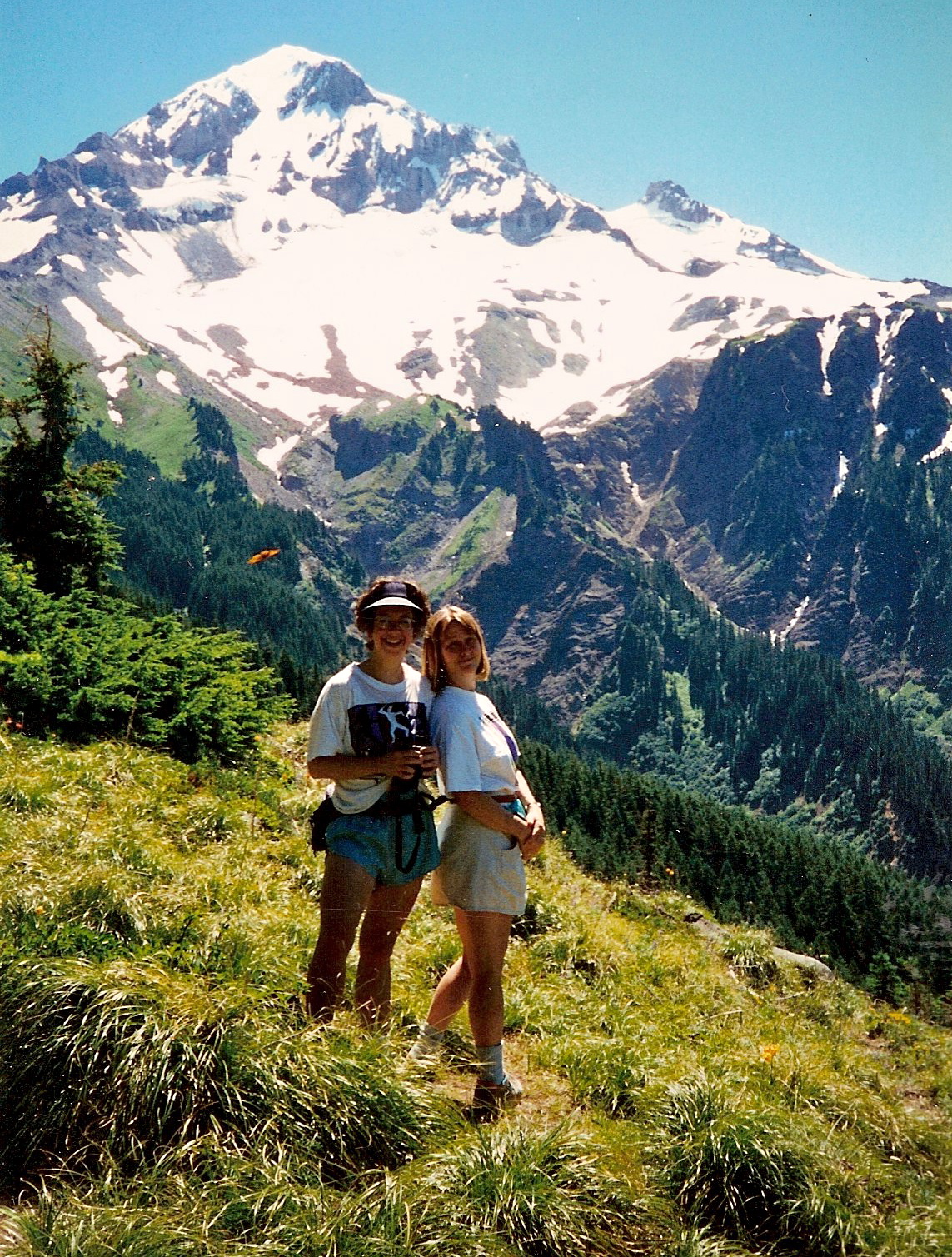
Dave and I like to tromp mountains. Lately the hikers we meet have seemed extra friendly. We happened on a young couple recently who were Pacific Crest through-hikers, and they couldn't stop smiling at us. Later I realized why. Oh look, Jason! Old people! They're adorable, and so ambulatory!

For years I've come upon those wonderful old ladies on the trail myself, with their sensible haircuts, sun hats, wrinkled brown knees, and walking-sticks, and I've thought: I hope I can be that cool some day. I hope I don't spend too much time mourning my waning youth.

Thank you all very much for pointing it out, and right you are: my youth is all waned out already. So how pathetic is it to cling to advanced middle age? It's not like I haven't always known that I didn't have it in me to forestall any of this. I haven't even worn makeup since I was sixteen. I'd never be able to justify cosmetic surgery, with the world in the shape it's in and so many in need. Beer, sure. Surgery, no.

Earlier Murr, with Linda
I suspected that the transition from reasonably presentable middle-age to saggy old batdom would be a painful replay of the anxiety of adolescence, when I allotted ungodly amounts of time to my hair and strove to come up with a passable wardrobe on a Lerner's budget. As it turns out, time does not march in rhythm: it lurches and staggers. One day your face is baby-butt smooth, and the next morning you have sprouted an inch-long bristle borrowed from the snout of a boar. I was just forty when I first noticed my neck wobble. It was a Tuesday. I sturdied it up, jutting my chin toward the mirror, until the vision was forgotten, only to find my cat entertaining herself by sitting in my lap and batting my neck back and forth that very night. Most people get a little more time for their denial. Things really started to slide after that. I made my accommodations as I had to, but I didn't feel gracious about it. Something, I felt, needed to be done, but old hippie girls don't have a lot of tools in their kits. When our outside age doesn't match our inside age, there's nothing we can do. We're not even allowed to mourn. We've got the baggy cotton dress and a well-rehearsed look of faux serenity, and that's about it.

Then, quite recently, I turned my attention to other things for a couple weeks--weeding, writing, writhmetic--and then I glanced in the mirror as I was stepping into the shower and FWOMP: there it was. Certifiable, unmistakable, readily identifiable old-lady's body, right there. Textbook case. Little draperies hanging off the armpits, muscle tone out the window, dimples in a doughy shoulder, and pleats of flesh dangling like flounders under the shoulder-blades. Meanwhile, around front, the balloons on the parade stand were now hanging off the platform like bunting. It was riveting. It was such a sudden and complete transition that I couldn't even take it personally. I'd seen it before, on Senior Day in the shower at the Y, on old women who had already traveled beyond the trivial concerns of vanity. And there it was in my very own bathroom mirror. I was actually able to regard it with something like affection, mentally accessorizing with a sun hat and walking-stick.

Well, that's over with, I thought, and was left with only a few questions: how much value should be given to physical beauty in our modern culture? How important is it to face one's own mortality? And, where does the Michelin Man buy his pants?
When all else fails, keep your arms in the air.

Saturday, March 31, 2012

The Pencil Test

There's a new boutique down the street called "The Pencil Test." It's a bra shop, named after the antique advice that if you can hold a pencil under your breast, you need a bra. The word "need," here, is in the context of adolescence, which operates under strict social rules, rules that are absorbed by the adolescent quickly and so thoroughly that she can remember them fifty years later even if she is foggy about everything else. This is why I can recall exact uniforms associated with the caste system of Williamsburg Junior High. Outfits from Villager and Ladybug secured with a circle pin put you at the very top, and Lerner's knockoffs kept you just above the Untouchables. Anyway, the pencil test serves as the last opportunity to get with the program, although there are plenty of opportunities to jump in early via the Training Bra. The training bra is employed at a stage when the only thing that needs holding up is the child's social standing. It's there to fend off mockery and introduce her to needless discomfort early, lest her childhood be squandered on joy. A true training bra would be much more useful late in life when the little wheels might help keep things from sliding off the sides.

I don't think there is a jockstrap pencil test for adolescent boys, and it's just as well. They'd be dropping that pencil every ten minutes.

One good thing about the moment you need a bra is that, theoretically, it coincides with the time you no longer need a pencil holder. In truth I never used a pencil holder. That was one of the ten items on the list of school supplies we were required to show up with in first grade. I remember going shopping for them. It was thrilling. I didn't own much. But now I had pencils, a plastic zip pencil holder, a perfect rectangular gum eraser with the brand name still visible on it, and a composition book with a black-and-white nubbly pattern on the cover. The pencil holder presided over the successful transfer of my pencils to my very own desk in first grade, and that was the extent of its service. Not too many years later, I was growing my own.

That's an interesting time. I hadn't really paid much attention to boobs until they showed up in the adolescent school supply list along with nervous tics and Clearasil. When it comes to boobs you're at the mercy of genetics, but you're not clear about that. It's all a mystery: when are they going to start? And then, when are they going to stop? You check yourself out in the mirror every day to see how the project is coming along. In fact, that was what I was doing the very last time my father opened my bedroom door without knocking, producing a flash of intense embarrassment all around, tinged with--on my side, at least--remorse that Daddy's little girl was leaving home and there was nothing I could do to stop her. On the plus side, progress was being made. In the absence of actual money, with which I could have bought a Villager outfit, I was finally able to develop some social currency of my own. Before long I was able to transport a boxed set of Prismacolor pencils, 128-count, with no hands, should the need arise.

That's undeniably handy, but it doesn't stop there. Many of us have proven to be able to grow entirely new body cavities over the course of our lifetimes, allowing us to cache contraband in our own back folds. I'll give myself another ten years and I'll be able to line up all my pencils one by one down my front and roll them all up jelly-roll style, tucking in between a pair of chins. By that time nobody will be looking anyway, and it beats carrying a purse.

Wednesday, November 30, 2011

Forced To Curl

I don't remember many dark moments in my childhood. Mom was a pleasant, smiling, patient woman in a calico dress and apron who smelled like bread baking, and at least once a day she would give me a big hug and call me her sweetie-pie sugar-plum honey-dumplin' puddin'-head, all in a row like that so she wouldn't forget any of it, and she sang You Are My Sunshine to me, and let me lick the beaters, and once I'd been lulled into a position of complete trust for seven years, she pinned me down in the kitchen and gave me a Toni. It burned and smelled like curls and cancer and nothing in my life had prepared me for my mother trying to fry off my head. My straight hair was unceremoniously abbreviated every couple months, and Mom evicted it from my forehead every morning by raking an all-day Barrette Of Death across my scalp, but I'd gotten used to that. The problem, as she saw it, was that I wasn't enough like Shirley Temple. There was never a chance I'd be able to tap-dance, either. Even when I tried to skip, it just looked like my knees had the hiccups.

Thrilled
The Toni was horrible. It didn't last long, but I was mortified. I wasn't interested in anything girly. I died a little inside whenever Old Man Balderson next door called me "young lady," which he always did, thinking himself nice. I briefly owned a single neglected doll, a gift from a distant aunt who didn't know me well, but that was it; I played with stuffed animals and real frogs and salamanders. That awful Halloween when the girl in the pink princess outfit got a prize for Prettiest, it struck me as an outrage of cosmic proportions. Just the idea that "prettiest" should be a category was wrong. What kind of mixed-up world was this?

Clothing was strictly utilitarian. In fourth grade, I picked out a drab blue school dress that I liked well enough, and my parents did too, so they bought the exact same dress in brown also, and that plus the Bluebird outfit was it for the year. It would still be several years before I recognized that the two dresses, and I, were totally inadequate. Kids today are much more advanced, and pick up on humiliation at a much earlier age. A stroll through any girls' department these days will reveal aisles of unrelieved pink froth and Spandex, and your only choice is spangles or not so many spangles. And apparently they like it. I would have died.

So I guess my aversions made me a tomboy, except that I couldn't run, climb, throw, fish, or do anything else in the tomboy canon except fall down, scrape skin off myself, and feel squirmy in my Sunday best. I was a happy little girl, Mommy's sugar plum, and I was fine just the way I was. Until I got to junior high school, and learned that I was not fine just the way I was. In fact, I wouldn't do at all. There would have to be some big changes made. When cheese goes through the grater, it all comes out the same way, and if I didn't want to be a little autistic cheese molding on the back shelf, I would have to press into that metal, even if it hurt.

I hesitated at the door to adulthood, as though it held a gibbet. I was only eleven, but I could see my future clear as a teardrop: to step forward was to step away from my authentic self. It was going to take guile, and trickery, and concealment, and a little more money than I had. One day I blurted out to the prettiest and nicest girl in school that I didn't want to grow up, and she said she didn't either. But I didn't want to have to do it. I just had to do it.

I wasn't very good at it. Fortunately a few years later the flower-child era was ushered in to match my budget, and I got by on jeans and work shirts and too much eye-makeup, which my parents did not approve of. They thought it made me seem like a whore, but it didn't. It was the sex that did that. The makeup did look dreadful. I only have eight eyelashes and it takes a herd of mascara to get them to show up. Plus, my eyes are tiny and set too close together, which is not what you really want to draw attention to. There was always the option of painting the outside corners to show where my eyes should be, but the effect is much like what the City gets when it spray-paints around the little potholes it doesn't have enough money to fill in yet.

I carved out a tiny social niche and had just enough self-assurance by my senior year to recognize the opportunity to quit wearing makeup when I went off to college. Women think they look like hell without makeup, and they do, if you're used to seeing them in it and they show up without it one day, but if they never wear it they look just fine. So I went to college scrubbed up clean and haven't used any cosmetics since. I have to date saved $132,000 in spurned makeup, enough to have bought every child in Bolivia a heifer, but I spent it on beer instead.

The best thing is, I can see my authentic self again from here. It's a little scuffed up, but it's coming into view.

Saturday, November 20, 2010

Tressed Out

If you can use your own hair to floss for dingleberries, is it time for a haircut?

If your houseguests comment on how brave (they don't mean brave) you are to have carpet in the bathroom, and you don't have carpet in the bathroom, is it time for a haircut?

Lest anybody tell you otherwise, I have a lot of hair. It's just that half of it is no longer attached. It's all over the house. It gallops along the baseboards, it clumps up in the recliner, it lurks in the drainpipes. There's no denying it, either. When your guest begins pulling a strand from the casserole, and is still pulling it a minute and three feet later, it's mine. Lazy birds scope out my hairbrush for pre-fab housing.

Most of my life I've had either very long or very short hair. Mom used to stab a barrette in it that would stay all day. The clotted blood probably helped. As a teenager I grew it out. I parted it in the middle and sent it to my waist without detour. I dried it into a perfect curtain while pressed up against the back of the sofa, and if an unauthorized pleat showed up, I ironed it out. There wasn't a crinkle in it. It was perfect mid-1960s hair, and it was my adolescent ace in the hole. I may have had to shop at Lerner's, but I didn't have to sleep on soup cans to straighten my locks.

My favorite all-time haircut was a buzz job that stood straight up if I put enough product in it. If I got it cut in the evening, it would look fabulous until about four o'clock the next day, and then I needed a haircut again. I've never been able to part with the cash for makeup or frequent haircuts, so I had to let that one go. Various in-between efforts were stick-straight and limp, so sometime after age 50 I went for the long again. I braid it to keep it from jumping ship every minute of the day. But it's falling out, and here's the thing: now it's not coming back. I finally realized this one day when I had Section One in my hand to begin my braid and went for Sections Two and Three, and they weren't there.

This is another of those tricks that those comedians the Hormones play on you. After a certain age, your hormones inform you that you are no longer of any use to the gene pool, and so you will not be needing your looks, and that includes your hair. Where once you had hair with no body, now you have body with no hair. Without getting into too much detail, this can be okay in some areas, but in other areas you're going to miss it.

So now I have a braided tail that would disgrace a damp whippet and my face is getting wider and taller. Am I keeping it long because I have so little left? And if so, how much less pathetic is that than a comb-over? Something must be done. I have an idea what a lopped version might look like, but it is Ursula Le Guin's literary prowess, more than her haircut, that I aspire to.

So I hesitate. But I had the right hair when I was thirteen years old and it mattered the most, and you can't take that away from me. And when I'm sitting on the toilet, I still have a couple of options available to me: turn my head, and coif.