Showing posts with label Echium "Mr. Happy". Show all posts

Saturday, June 8, 2019

All Bloom And Bluster


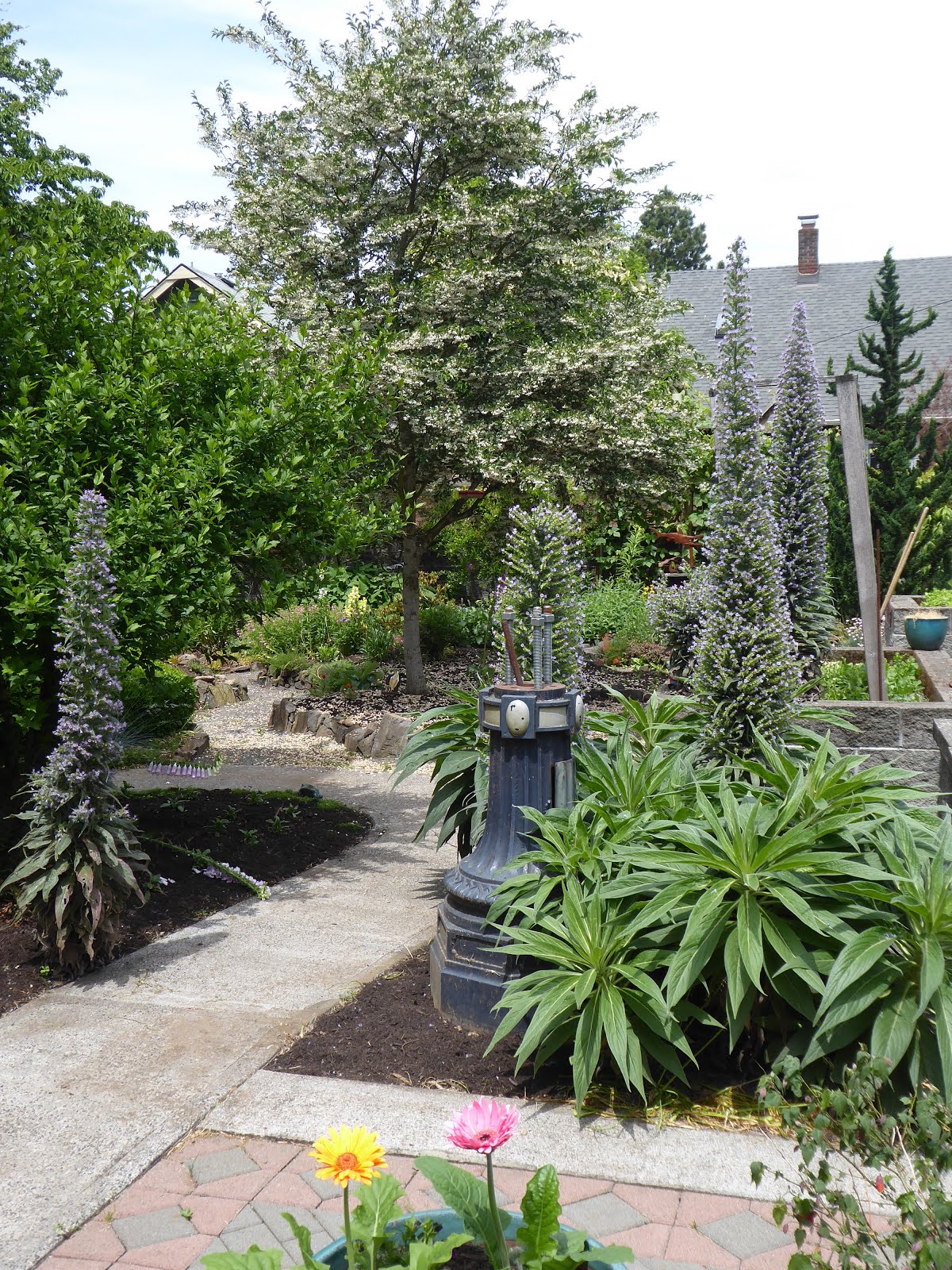
Truth be told, the foxglove population here has been demoralized for years. It started when the Echium "Mr. Happy" was brought home in his little four-inch pot and settled in the ground. Not much to look at, at first, but his tag was all braggadocio. He was going to be something, boy howdy. Ten-foot spike with impressive girth, like you've never seen.

Some of the foxgloves warned, darkly, that this was going to be trouble, and kept going on and on about this being one more northern foothold in the Californification of the garden, blah blah blah. But no one cared. Mr. Happy wasn't bothering anyone else. The annuals gabbled away as the one-season wonders they were. It's just a big ol' rosette, they said. The more the merrier, and all that.

But the foxgloves had been the dominant biennial flower spike of the region for a couple hundred years, and they had a more mature perspective. Nothing good could come of this. Have you no sense of heritage, they said? This is not normal, they said.

Pssh. The zinnias didn't care for all this gloom and doom, and, if they were to be honest, they thought the foxgloves could stand to be knocked down a peg. Don't worry about it, they nattered, unbearably cheerful as always.  No way he's going to make it through the winter. He's a flash in the pan.

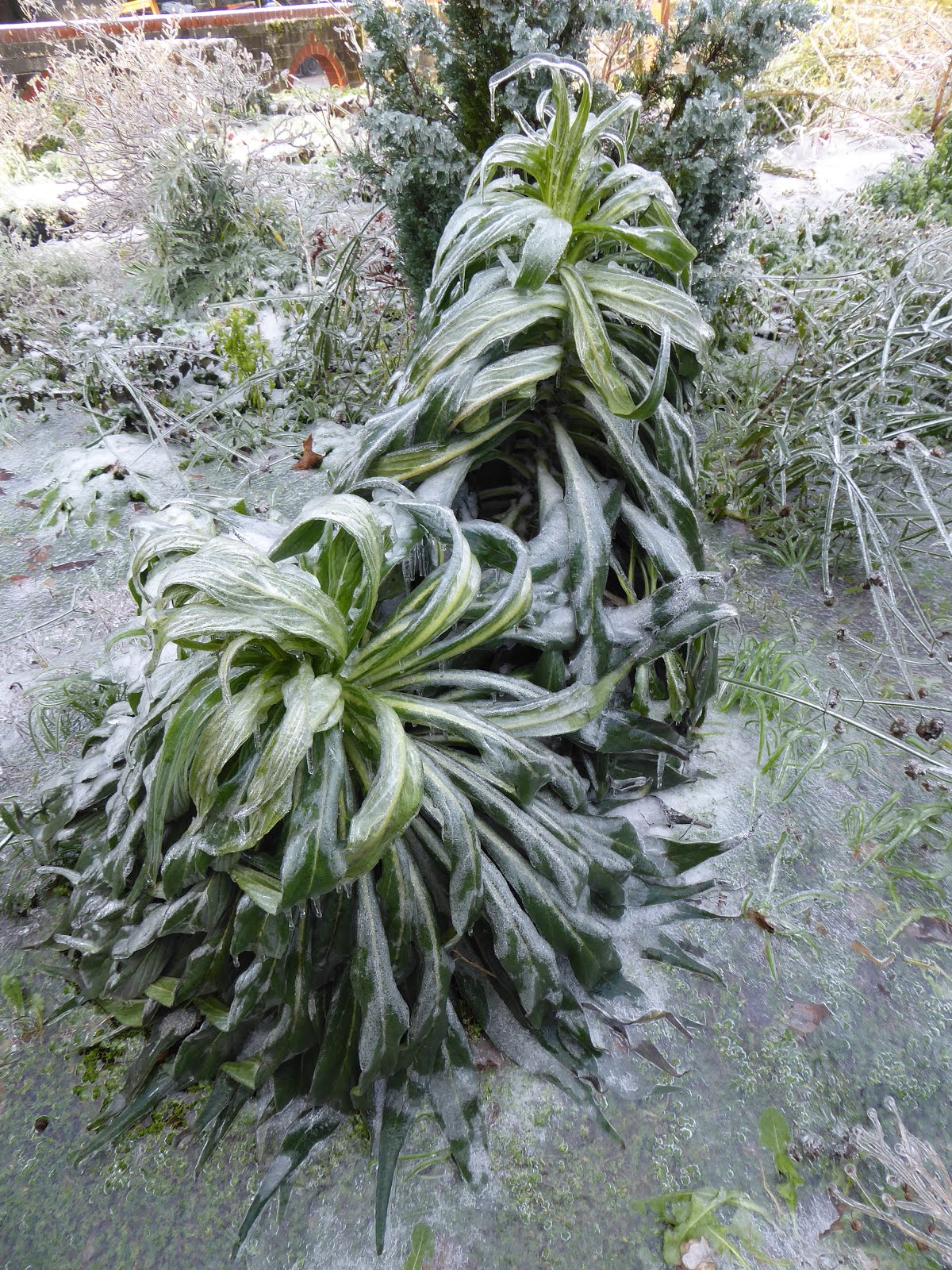
The foxgloves began to relax. Mr. Happy was a buffoon, a joke. He's just an entertainer--he's not going to ascend to his bloom year. The foxgloves settled into proper dormancy for the winter confident that the upstart would be revealed to be the clown he was, come spring. But they had not counted on all the behind-the-scenes support from unknown benefactors. The plastic wrap. The light bulb.

And to their shock, the next spring, there he was, still among the living, and he quickly shot up into the sky, surpassing the foxgloves in height, girth, and glory, and proceeded to go on and on about himself all summer long. The annuals were impressed. Annuals are easily impressed.

The foxgloves conferred and came up with some proposals but nothing made it out of committee. It was infuriating, they thought. How could it not be obvious that Mr. Happy was an impostor, a bluffer, a fraud, nothing but a big-ass tower of bloom and bluster with no qualifications whatsoever? How could he be Number One? Why are the zinnias falling for this fool?

Mr. Happy is the greatest. Mr. Happy is the biggest. Mr. Happy is the best. How could anybody believe this crap? The foxgloves laid out the situation, hoping the truth would win the day. But nobody cared. Look at how all the bees made the shift, they said. Everybody's so busy. Mr. Happy is totally a job producer.

The foxgloves grumbled helplessly. Job producer, my plump pink petals, they said. Bees will work for nothing. Employment numbers don't mean anything  if everyone has to work five thousand blossoms a day just to make it.

And so on. Until this year.

It started with murmurings in the understory. Sharing of scuttlebutt. Botanical buzz. The first stirring of hope among the beleaguered foxglove community, and whispers that their long, yardular nightmare may be coming to an end. Mr. Happy's grandkids have arrived.

And what a motley crew they are. Pinko. Stubby. Knobbles. Slim Jim. Fuzzball. Who's your daddy, Mr. Happy? Hmm? Because there's a lot going on in this woodpile. Different sizes. Shapes. Colors.

The foxgloves want it to be known they have no trouble with a little color variation. But they have a feeling Mr. Happy's base doesn't see it the same way. Heh heh.

Wednesday, June 6, 2018

Staying Up For The Second Show

You all remember Mr. Happy. Mr. Happy was the little plant I bought four years ago with the salacious tag in it. He was the biennial that was supposed to grow for a season and then winter over and, when he reaches maturity, which in this case is what anyone else would call puberty, he was supposed to rear up into a gigantic pink flower spike of impressive girth and length. But you have to get him through the winter first, and since he's a Southern boy, he's not equipped for our winters. It would be touch and go all the way.

Nevertheless with the help of Dave, who wrapped him like a baloney sandwich during a cold winter night and, uh, fluffed the soil--let's go ahead and call that his nocturnal mission--he persevered and did exactly what the teaser on the plant tag suggested he might do. I don't know why Dave put himself out like that; he's a compassionate fellow by nature, and maybe  he related somehow. But when Mr. Happy burst into bloom in the spring, there was nothing subtle about it. He rocketed out of his short hairs in an explosive fashion, and he didn't begin to peter out until nearly winter.

Echiums are self-fertilizing, so he was able to play with himself, and that's all he did all summer. By the next spring, his kids were all over the place. There are pictures of Echiums thrusting out of the ground in profusion in their native California, full monty, and it's pretty clear you could get a show like that in no time starting with just the one plant, if your soil is suitably lascivious. I thinned out all but about a dozen plants and hoped for the best. Last you all heard about it was in December 2016, when I still hoped they'd winter over, but they withered and died, every last one.

Which was disappointing, but ultimately fine. They're not natives, and there's no real point in having them here except as a novelty.

But then, last spring, darned if there weren't another thousand Mr. Happies sprouting up everywhere. And I let them. These would be the original Mr. Happy's slower children, I suppose, but we're not here to judge, and if we were, we'd be judging their behavior. And we had another cold snap, and although I did not wrap them like a baloney sandwich, I did toss a prophylactic over the biggest group of them and gave them stage lighting, and they're all still going, and spring is right around the corner. This could really be something.

Original Mr. Happy was our backdoor man, so you didn't see him unless you went down the alley, as it were. Maybe they're used to this sort of thing in California, but around here putting even one Mr. Happy in your bed would be like showing up at the dog park with a camel. People will notice. And now we have way more than one.

They're all over the place. It's going to be a detonation. I'd say they go off like the Fourth of July, but it's really more like the last scene in Behind The Green Door.

Update: Only a few of them went off. They're different sizes and shapes. Intimidation might play a role. Or maybe most of them just like to watch.

Saturday, December 31, 2016

The Misters Happy

You all remember Mr. Happy. Mr. Happy with his gigantic eight-foot pink spike of flowers that lasted for months and months? That Mr. Happy. He was from down south but we planted him as a tiny rosette in 2014 anticipating the flower spike in 2015 if we could just keep him alive over the winter. Californians prefer things a little hotter than we like them here. But Dave wrapped Mr. Happy in plastic and added a light bulb and saw him through the coldest days and sure enough he lived long enough to erect a towering pink spike with impressive staying power. And that was that. Mr. Happy is a two-year plant.

But! Last spring I had a look around and found all these tiny little rosettes that I didn't recognize at first; especially in the pepper garden that Mr. Happy towered over. They all had a distinctive rash of speckles that didn't clear up. Mr. Happy! He'd gone all Charlotte's-Web on us. There were dozens at first, then hundreds of Mr. Happies all over the place.

Sure enough Echiums like Mr. Happy are self-fertile, so there is no reason to introduce a Mrs. Happy, and what he'd done all summer long was play with himself and spray his seeds all over everything. I weeded out most of his kids last summer but still had a few dozen placed hither and yon, and I hoped for a mild winter. A giant pink spike of flowers is startling enough in Portland: an army of them would pin people's ears back and cause sensitive souls to fan themselves and make for the fainting couch.

But now it's December, and it's been cold. They're starting to look right sulky. I fret about them. I bring them up in conversation a lot. "Mister Happies" never sounded right. I've started referring to them as "The Misters Happy."

That's old-timey. My spinster great-aunts Gertrude and Caroline, who lived together and both to an overripe age of about a hundred and forty, always used stationery printed with "The Misses Brewster." Neither of them married. They both graduated Smith College and taught English, and then they retired and sat around in straight-backed chairs and waited to die. Every year we would get a fruitcake from The Misses Brewster, wrapped in foil, or maybe it was a plum pudding; it was dark and ponderous and antique-looking and dense as a black hole and it was accompanied by something called Hard Sauce, which is not especially hard. It was pretty tasty, but if you ate too much at once you'd want to take to your bed with a spot of laudanum. My father told us that Aunt Caroline was the one who made the thing, wrapped it up, addressed the box, slathered it with stamps, hitched up the mule, and saw it to the post office, and Aunt Gertrude took the credit.

Aunt Gertrude was the elder of the two. That's the sort of thing that should make more of a difference when you're four and two than when you're 104 and 102, but apparently it didn't. Dad also told us Aunt Caroline had once found a man she wanted to marry, but he was Jewish, and the family did not approve. So she never wed, and she instead looked after her older sister until she finally quit waking up, and then she died herself.

The Misters Happy are not going to live to a hundred. They're looking at two at the outside, but that's okay with them. They don't know beans about fruitcake, but if everything works out right, they'll be spraying seed from spring to fall, and they don't mind if you watch.

Wednesday, May 20, 2015

The Rise Of Mr. Happy

There was a time when we thought Mr. Happy would never rise up, would remain just a withered stump of a thing. But we were wrong. Mr. Happy is standing up straight and proud and pink, a little disheveled around the dark curls at his base, but still a sturdy spike of glory. He's magnificent. One look at him and you can tell he doesn't belong here. You can hike all summer long around here and not run into another ten-foot-tall tower of flowers. The other way to tell is to remember how many days Dave had to wrap him in a blanket with a light bulb for heat and read "Charlotte's Web" to him last winter. It ain't natch'l.

So I'm not getting away with anything here. If I was planning to get an official certification as a Backyard Habitat, Mr. Happy would put the lie to it. It would be like trying to shoplift a refrigerator under my overcoat. People can tell.

I've only recently become aware why someone would want to have a certified backyard habitat. Rules aren't stringent. Someone needs to come by and see that at least five percent of your vegetation is native to the area. Five percent. Why would anyone want to have a garden with just the same straggly stuff you could see in the local woods anyway? Glad you asked.

It's a little lesson in evolution. Every living thing is trying to get along. Get along in life, that is, and not necessarily with each other. Definitely not with each other. It's eat or get eaten. You have a plant that wants to eat sunlight, and a raft of caterpillars that want to eat the plant, the plant is going to have an opinion. And it's going to back up its opinion with some chemical defenses. And sooner or later some branch of the butterfly family tree is going to do an end run around those defenses, and that's where the eggs are going to be deposited. If the emerging caterpillars manage to chew the plants all up, then they've screwed themselves too. But if the birds pick off most of the caterpillars, leaving just enough of them to keep the butterfly franchise going, everyone makes out. What you are witnessing in a natural landscape is the truce that remains after everyone's done duking it out.

This balance the plants and insects are achieving as they dance through time together can get to be pretty precise. Many butterflies are adapted to one host plant only. You start carting them out and replacing them with pretty flowers that evolved somewhere far away, you'll find your insect population at a complete loss. You strip-mine the Midwest with Roundup so you can replace the native milkweeds with corn and soybeans, you'll crash the monarch butterflies. They don't have thousands of years to come up with a new plan.

This is not good news for the birds that are counting on the insect hatch to feed their own young, like
our chickadee friends, the Windowsons. It takes a whole lot of grubs to raise a baby Windowson. They're hauling them in so fast it looks like Lucy Ricardo and Ethel Mertz doing an episode in a sausage factory. Visualize an endless chain of links pouring into the birdhouse. Your pretty new garden does not provide enough little green sausages for the bird population.

Fortunately for you, you don't remember when there were ten times as many birds. Or ten times that many. That was in your mom's era, or your grandma's--might as well have been the Cretaceous. So you're free to enjoy your exotic flowers. I know I do.

But I'm still keeping my favorite invasive species, Tater Cat, indoors, and when Mr. Happy finally shrivels up--he can't last forever--I'll think about slipping in a nice local flowering currant.

Wednesday, January 7, 2015

Mr. Happy


I think it's fair to say that both Dave and I are worried about Mr. Happy. Mr. Happy started out small but rumor had it that if everything went right he'd push up a gigantic spike, with girth to rival its length, a veritable tower of pink. I've kept him in my bed since last spring, just waiting.

Mr. Happy isn't just any old Echium. But the truth is any Echium would find this place a challenge. I saw him in the neighborhood once so I know it's possible. I didn't know who he was at the time. There was a ten-foot, massive, rigid spike of flowers in somebody's parking strip, right next to all the skid marks. Might be the kind of thing that's just ho-hum in California but around here it's a statement. And the statement is oh baby, oh baby, oh baby.

So I recognized him when I saw his picture along with his Personal Ad on the little tag in the nursery. He was in just a three-inch pot and he was a four-dollar gamble. The problem was he wasn't going to put out until his second year, and he wasn't going to have a second year if he couldn't make it through the first winter. For four bucks he was worth a try. Sometimes we never get much below freezing here. Back in November we'd already had a cold snap in the mid-twenties and I thought Mr. Happy was a goner, but he just got a little ragged on the edges and still seemed quite enthusiastic in the central well-hello-there zone. Temperatures rose to the forties and stayed there for weeks on end, and then this happened: lows predicted around twenty, for days.

We got to work. Dave pounded in a couple stakes and got a few hundred dollars worth of Costco plastic wrap and bundled up Mr. Happy like Kathy Bates in Fried Green Tomatoes. He put a sleeping bag on top and a 100-watt bulb underneath. Late at night he trotted out with hot chocolate, a binky, and some Vicks Vapo-Rub and read to him aloud from The Wind In The Willows. I looked out the window with love in my heart and thought of my mommy. Specifically, how, in the days before plastic wrap, days which we were now revisiting, she was able to bundle up a sandwich in waxed paper with hospital corners.

Mr. Happy glowed in the cold and the dark like the Baby Jeebus in a nativity scene. We don't know how it's going to go for him. It's nothing I'm going to say in his presence, but just in case, I've already begun to work on his obituary. I'll have to send it to the L.A. Times. That's where all his friends are.