Wednesday, August 10, 2011

Getting Away With It

The official version [wink] is that nobody knows where all the money that regular people used to have went, but hey, they're starting to make some progress in the old D. B. Cooper case, so that's something. "D. B." is not the hijacker's real name, but a journalist's typo for "Dan Cooper," which is also not the hijacker's real name, which might be Tim, or Mitt, or Michele. At any rate, he boarded a plane from Portland to Seattle one night forty years ago, and held the passengers for ransom, eventually exchanging them for $200,000 in cash and four parachutes, and he bailed out of the airplane somewhere over the wilds of Washington during a raging storm. He has not been seen since.

Sasquatch Hypothesis Has Historical Precedent
A few personal effects were retrieved, including his necktie and a number of Raleigh filter cigarette butts left on the plane. Now the FBI has identified a credible person of interest in the case, a person who is currently dead, but only ten years dead, which is less dead than D. B. would have been if he had perished in the jump. Now they would like to retest the cigarettes for DNA and compare that to some relic from the dead suspect or germane corpse particles, but no one can find the butts. The agent in charge of the case believes they might be in Las Vegas.

Nine years after the hijacking, a small portion of the ransom money was found in a river bank. This supports the hypothesis that Mr. Cooper died in the parachute attempt, or, as some have seriously suggested, soon afterwards, possibly after an encounter with Sasquatch.

Whatever his fate, D. B. Cooper has become something of a folk hero to many who cheer his moxie and hope that he might have gotten away with the caper. Many Americans are strangely moved by the thought that it is possible to make off with oodles of someone else's money, and are willing to overlook the fact that each of us is paying for it in one way or another.

So let's review. Someone whose identity remains in the shadows pulled off a heist, stole money he had not earned, flew directly into a storm and engineered a bailout, stashed some of the money in a bank and hid the rest, and planted stories about bogeymen to steer us off his trail. The FBI lost their butts in Las Vegas, and everyone else is so dazzled by the money and the audacity of the crime that they are willing to overlook grand larceny even if it was some of their own money that was stolen. It's just another great American success story, according to representatives at Republican National Committee headquarters, interviewed during the recent dedication of their new D. B. Cooper wing.

Saturday, August 6, 2011

Senile In Three Languages

If you live long enough, your language begins to get holes in it. It's like any other fabric you've nearly loved to death. Most of the holes in my home-team language have developed in places formerly occupied by nouns. I'll be traipsing along in a merry conversation and suddenly I'm brought up short at the edge of a pit, looking into it for my noun. They come back eventually. It's like how you shake out a sweater that you'd folded up from the laundry a while back, and out comes a sock that had been missing long enough that the mate had been thrown away. Same thing with nouns. You'll be having a conversation and someone is going on and on about the plutocracy, and then something he says shakes up your brain-closet and a noun you were looking for days ago drops out. "OTTOMAN!" you shout, suddenly and irrelevantly, which does nothing to shine up your reputation for mental acuity. The point is, things turn up.

There's no real point in looking for the word if you can't find it right away. The other day I was looking for (it turned out) "celibacy," when really nothing else would do, and I almost had it cornered (I'm pretty sure it starts with a "v"). It's not an odd word, not one that should turn up missing on your average day; it's the kind of word that probably comes in a twelve-pack at Costco, nothing unusual about it at all; but it's gone for the moment and that's all there is to it. There's a word for this phenomenon, and I don't remember what it is, but we might as well call it "dementia" because that's what everyone else calls it. I got to wondering if dementia manifests itself differently in different languages.

There are fundamental differences in the way languages are set up and they might even affect the way the speaker thinks. For instance, I am told that there is no word for "no" in Gaelic. If you speak Gaelic, you have to indicate a negative by recasting the question. If someone says "do you have new shoes?" and you don't, you have to say "I do not have new shoes." This simple deficit in Gaelic led to some terrible famines in days of old, when the Romans came through bearing platters of pasta and speaking a mile a minute and said "have you eaten?" and the Irish said "we have..." and that was that for the Romans--they kept on going and talking a mile a minute and didn't stick around for the "...not eaten."

My suspicion is that the Germans have the best setup for dealing with dementia. They already concoct their nouns as though demented and have a lot of practice. They would call an ottoman something like the thingonthefloorforputtingthefootsenonen, which is just the way I have started to speak. So nobody's going to notice. By the time they get to where they can't whomp up a noun on command, it works even better. The Germans start out their sentences by laying out all available nouns and then let you know what they want done to them later on in the sentence. They're not going to get caught halfway into their thought and then pull up short, gesticulating wildly, face screwed up, so God and everybody can tell they've just blown a fuse. No, they won't say anything at all; they can't get a purchase; they're thwarted from the get-go. They will remain silent. And be thought wise.

Wednesday, August 3, 2011

A Forbearance Of Brewsters

Great-grandfather Brewster
When Elder William Brewster herded his flock into the bowels of the Mayflower to come to America, he was a man of vision. Nowhere was his vision more in evidence than when he looked into the possibility of a world filled with Brewsters and concluded there was no reason to rush into things.

My ancestors have been deliberate to the point of sludginess when it comes to passing on the family genes. Only ten generations separate me from the Mayflower. Brewsters have been parceled out on an average of once every forty or fifty years, or only as often as necessary. Decades go by, and then someone finally points out that there should be someone to hand down the pewter tea set to; and if that didn't sway, the suggestion is made that without a renewal of Brewster blood, the world will edge into a soul-corrupting sunniness. "All right," the elder says. "Just this once."

Grandfather Brewster
They approached child production with the same gusto with which I respond to the frequent pleading emails from the Democratic Party. I know I must deliver; I give them what I have to and not a dime more, and there's no joy in it.

My forepilgrims were a dour, gloomy and sober bunch, much afflicted with piety. The entire prospect of renewing the family line filled them with humiliation and distaste. One imagines that the Elder William Brewster would have been relieved to hand the job over to a solitary sperm with a winch and a work ethic. As it is, he and his progeny through the years managed to eke out a knob on the skinny family tree two or three times a century. One doesn't sense enthusiasm.

He himself got the whole ball rolling with a starter set of five children of his own, each one representing a single horrifying episode of fleeting desire. Only because he sacrificed his body to produce the five originals do we have Brewsters to this day. Fewer lines and the venture would surely have fizzled out. He named his children Patience, Love, Jonathan, Fear, and Wrestling. I am, of course, a child of Love.

Father Brewster, clearly thrilled
"Wrestling" was, according to my father, short for "Wrestling With God," a losing proposition if I ever heard one. Talk about setting a kid up for failure. I'd like to think that if I had had children, I would have chosen less daunting monikers.

It's a reproductive rate barely adequate to maintain a line in the phone book up till now, and then I slammed the lid on the whole undertaking. It's a shame, too. I would have enjoyed meeting my children, Sloth, Elasticity, Flatulence, Torpor, and Twiddling. Twiddling would have been such a well-adjusted child.

Saturday, July 30, 2011

Driving While Stupid

"Just drive the way you normally do for the first 1500 miles and your car will figure out how you drive and adjust itself accordingly," the salesman said when I bought my Toyota Yaris four years ago. It was an odd instruction. How else was I supposed to drive? Was I supposed to drive normally for 1500 miles and then really schiz it up after that?

This was my first automatic car. The shift includes a third gear snugged into the same slot as "drive." And that's what I drove in for the first 1500 miles: third gear. Sure enough, my car figured out something about me that everyone else has known for years. "She's a little slow," my car whispered to the other cars in the parking lot, tapping itself lightly on the head gasket. "Let's keep it good and sludgy so she doesn't hurt herself."

And that's what my car did. It drove sludgy. It drove like a toboggan in cheese. Or a constipated possum. Or a Volvo. Climbing a hill, it had all the enthusiasm of a seven-year-old at bedtime. I kind of related to it in a personal way, but the whole point of driving a car is to get more pep than you'd have on your own. Plus, it was only getting 32 miles per gallon at best, which seemed wrong for a car the size of a postage-stamp dispenser. Once Dave noticed I'd been driving in third, I asked the mechanic if I could get a second chance to instruct my car how I drive. He pondered, squinted, then revved up his brain by snorking snot back into it, wiped his nose on his sleeve and said, "you know, I think it learns how you drive continuously. Just keep driving the way you normally do, only in drive instead of third."

I should have recognized this for the evasion it was. It was classic postal-handbook. When you work for the post office, you get numerous opportunities to placate customers. "Letters never get truly lost," you say. "It's probably gotten stuck behind the flap of another envelope, and it will shake out eventually and get back in the mail stream and we'll have it back to you, right as rain." As a customer-service gambit, this works because you want to believe it. Your customer wants to believe it. And you'll be far away by the time it becomes clear the letter is in postal purgatory, which is right next to unmatched-sock purgatory and the limbo of unrecalled words. We'll never see that little, what is that, little folded-paper thingy with the stamp in the corner--whatever--dammit--again.


My mechanic had no idea how to make my car forget it had ever met me. I may be able to race it to the top of a hill, but it has a way better memory than I do. I continued to drive it new-normally with no change in its attitude. Finally this year I brought it in for maintenance and mentioned the problem to a whole new guy with a whole different brain and he and his brain thought he could help. It worked. After four years, the car is demonstrating something close to moxie, and gets several more miles per gallon. "What did you do?" I asked.

Well! He unplugged the battery, and plugged it back in. Of course.

Wednesday, July 27, 2011

Things That Blow Up

It's July, and we're making great headway manufacturing our crack supply for the next year. Our raspberry crop is booming away out there and we can barely stand to divert a single berry from what we've determined is its highest and best use: syrup. The recipe is even simpler now that I ignore portions. The portions, as told to us, are One Part Raspberries to One Part Sugar, which even works in metric. I have trouble getting that much sugar into the jar, though, so I've taken to just filling up my big jars with berries and pouring sugar in until there's no more room. The jars get put in a cupboard for three months, six months, or whenever we get a notion, and then the berry sludge is strained out. The resulting smaller jars of syrup last us until the next season. It is poured on Death By Chocolate ice cream, which is available around the corner, and there's nothing I can make for dessert that's any better. "I could make a cheesecake, or a Boston Cream Pie," I tell Dave, and he gives it a moment's thought, and we both say "or we could get some Death By Chocolate ice cream and pour raspberry syrup over it," and that's usually that. Thus my entire culinary contribution for the whole year has now dwindled to about ten minutes of work in July.

The other day I was checking on the most recent jar of syrup, and it was all sticky. I wiped it down and discovered that it didn't appear to be leaking from the lid. Which made no sense. I got a thimble and put all my reasoning ability into it, and I still couldn't explain it. Could syrup possibly leak from the bottom of an intact glass jar? Move over, Einstein--it was only two or three minutes before I was able to correctly deduce that the source of the leak was the third jar back, after finally noticing that there was raspberry syrup all over the cupboard. That last jar was bubbling and working and jiggling its lid something awful.

It reminds me of the time I shared an apartment with two other girls, one of whom was a baker. Late one night there was a terrific explosion, and I pulled my blankets over my head while my roommates scurried out to confront the cannon-wielding intruder, and eventually ventured out myself. (I'm a great first responder as long as I get to go last.) The horror! The entire kitchen and most of the living room were coated in goo, glass, pickle bits, vegetable shrapnel, and what-have-you from floor to ceiling. I was still working on the cannon hypothesis and totally baffled, but my baker roommate was bold enough to taste a fingerful of guts hanging from the ceiling and determine that the culprit was the jar of sourdough in the refrigerator, which had blown up and blown the fridge door open and rained terror on the rest of the apartment. It was as if the Pillsbury Doughboy had  strapped on an explosive vest and declared jihad on the leftovers.

So I'm not usually the first one to figure things out. It takes sharper minds than mine to connect the dots in any situation. Take the current childhood obesity crisis in this country. Turns out that Richard Nixon once concluded the odds of getting re-elected were very low if people had to pay too much for groceries, and he directed that food be kept artificially cheap. That's when the massive price supports for corn began, and to this day we have tons of crappy high-calorie food made out of corn syrup, and it's really, really cheap. So our first lady can encourage us to eat fresh fruit and vegetables all she wants, but for most people they're too damned expensive compared to our subsidized crap. Ultimately they aren't as expensive once you factor out our tax contributions to the corn growers and the diabetes epidemic, but there's no real danger we'll be giving up that subsidy any time soon. Your average consumer will look only as far as the first jar--his grocery bill--and swallow the new narrative that the liberal elites are the ones who don't care about poor people, and nobody will follow the trail of syrup back to the jar in the rear of the cupboard. Even though it's our kids who are blowing up.

Saturday, July 23, 2011

A Mighty Wind

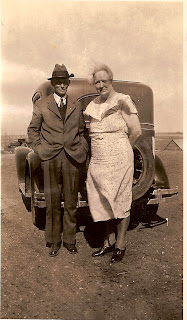
Hans and Petra, my grandparents
As an Oregonian, I tend to think my state stacks up favorably when compared with the other states, but I did suffer a flicker of envy the other day when I read about Arizona. A giant haboob just flew through there at speeds up to sixty miles per hour, and all we have is elk.

A haboob is a massive dust storm, and Arizona has a lot of them, although of course this one was a real dilly. Floods, tornadoes, hurricanes and haboobs alike have been overachieving for years now in spite of the sober judgment of dozens of prominent capitalists that there is nothing untoward happening with our climate. So it's a puzzler.

Myself, I put it down to the trend towards obsessive housecleaning. I am not trendy. My preference is to fail to notice dust in the house, which is easier if you don't disturb it and avoid sunbeams, which are rare here anyway. Over time, all surfaces develop a pleasing matte finish, and periodically--say, once a year or so--the whole accumulation can be neatly rolled up like felt. This is not the method preferred by my housemate, who suffers from higher standards. With his method there's never any end to it; you'll never quite get rid of the schmutz in the corners; and you can't tell where the cat has been.

A huge component of house dust is shed skin cells, which pop off the body and onto the coffee table in the hundreds of thousands per day, like an epidermal diaspora. The cosmetics industry has so far ignored the potential of a mixture of dead skin cells and Lemon Pledge as a suitable face spackle, but not for lack of a market. Somebody would buy it. In fact there are no doubt some individuals who are embracing the unparalleled exfoliating properties of a good haboob. If you should see someone standing out naked when the haboobs roll through, he's probably the sort who's already carved away his own nose and injected himself with botulism. You can draw your own conclusions, although none of them support evolution.

Thanks to the proliferation of well-advertised dusting products, people are waging war on dust in the modern era, many of them claiming allergies. Dust allergies, they say, are really allergies to dust mites, which are organisms that like to eat our skin cells and, like tiny polite vultures, are kind enough to wait for them to die and fall off of us. In fact, though, no one is strictly allergic to dust mites, which are actually too large to become airborne where we can inhale them. Instead, they are allergic to dust mite poop. If you were looking for another sort of factoid, you should have visited a different blog.

My own mother was a regular duster. She devoted one day a week to it and was probably glad to do it. Once a week with the bottle of O'Cedar was a cakewalk compared to the Dust Bowl, when the entire state of North Dakota, among others, lost its skin cells. She relates that they had to sweep out the entire house three times a day, with a shovel, due to the local shortage of backhoes. What roiled through the air was valuable stuff, stuff you could grow wheat in if you had a little water, but if you had a little water it wouldn't have roiled through the air. From what I gather, North Dakota may have been flat, but it had really big haboobs, although Mom never put it that way.

So it may have been her early experience that made my mom such a good housekeeper; I certainly have no evidence at hand that there was a genetic component. It would be interesting to see just how long I could go without dusting, if Dave weren't around to inflict tidiness. There is something comforting about the thought of watching the house fill up with my own skin. That might not spin your propeller, but it's about as close as we apatheists get to immortality. Maybe I could live long enough to see it wrinkle on the bookshelf. Maybe I could grow wheat.

Happy birthday, Mary Ann!

Wednesday, July 20, 2011

Uh-Oh: Not A Poop Post

A few weeks ago I took a trip to Uh-Oh World. Uh-Oh World is where everything is upside down and nothing is as it should be. In Uh-Oh world, W.C. Fields strolls through Disneyland with a sarsaparilla. Michele Bachmann takes up paleontology. The Pope gets caught in public without his homilies. And I don't take a dump for three days.

Not three consecutive days, but still. It's so wrong. This is not the sort of thing that is supposed to happen to me. No matter what I put in the top end, it is supposed to motor on through on schedule. I could eat a sofa and pass it in neat little pillows. Sewer rats set their tiny watches by me.

The first day I didn't drop a deuce was annoying but not, to tell the truth, entirely unprecedented. Sure enough things seemed to be back to rights the next morning, including what we will call the backlog. But something was amiss. There was a sensation of holding back. Specifically, there was an area of tenderness on the west coast of my GI tract in which I suspected some unauthorized malingering material. There was also a fever.

I got Dr. Google right on the line. Dr. Google suggested that I might have developed a diverticulum. A diverticulum is a little pouch in your intestine where you can store shit in case you need it later. This is the sort of idea that seems thrifty and sensible at first, but you follow that line you will end up with nothing but tiny aisles running through your whole house, as it were, and your relatives will be talking about an intervention. It's not good.

The whole beauty of shit is wasted if it doesn't come out where it can be appreciated properly. Without that, it is a noble thought unexpressed, a greeting card lost in the mail.

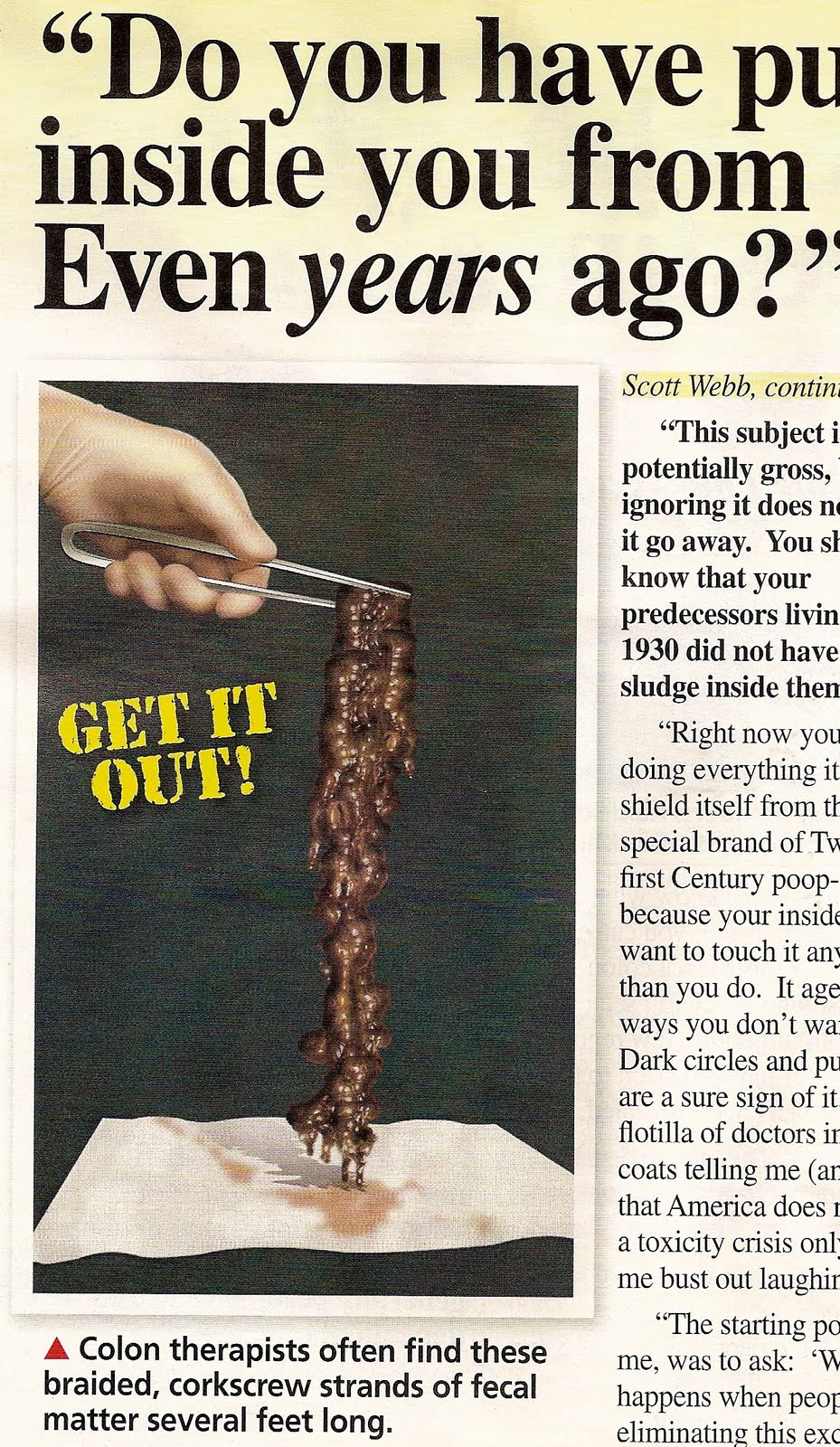
When I delivered mail, speaking of mail, I was particularly taken with the advertising flyers put out by some outfit hawking probiotics that warned against the dangers of a sluggish digestive tract. It was illustrated. "What does it mean if you have small, round poops?" it queried, showing a drawing of small, round poops. (My friend Carl knew that one. "It means you're a deer," he said.) Other drawings depicted a cross-section of the intestine after proper use of their recommended pill. It was not only pink and shiny but actually spangled with little star-gleams. In contrast, there was another illustration of a man holding what appeared to be the blackened, gnarly skin of a massive python on a stick. This, we were informed, was the actual content removed from a deceased gentleman's intestinal tract. Possibly with the stick. It was alarming. We were further informed that John Wayne was discovered, upon his death, to have been harboring thirty-five pounds of fecal matter, neatly explaining both his peculiar gait and the downside of fame.

Well, when I die, I am hoping for a better legacy than that. I immediately phoned the advice nurse at Kaiser and advised her of my turgid condition, demanding treatment. She was not unsympathetic, but suggested I might wait a few days to see if things resolved. The fever did go away, but it was another two days before the train came rumbling through, car after car after car. The morning commute is back on track, but I am not interested in being a person with diverticulitis, which Dr. Google told me all about. It's not my thing. Except for the possibility of flatulence in the urine. That part sounds sort of interesting.